


Speed or Learning: The One Choice That Will Define Winners in the AI + 5G Era
In the AI and 5G era, speed is visible—but learning is decisive. While real-time connectivity accelerates action, only organizations that build fast, disciplined feedback loops can turn speed into sustained advantage. The true winners will be those that use AI and 5G not just to move faster, but to learn faster, govern better, and continuously improve outcomes at scale.



Every major technology wave creates the same temptation.
We focus on what is easiest to see. We celebrate what is fastest. We measure progress in the most visible metrics. More bandwidth. Lower latency. More devices. More automation. More scale.
In the AI and 5G era, that temptation is especially strong because speed is tangible. You can measure it. You can demonstrate it. You can show a device responding instantly and make people feel the future.
Learning is different. Learning is quieter. It is harder to see in a demo. It is slower at the beginning, and it often requires uncomfortable work: changing processes, upgrading data discipline, building skills, redesigning decision rights, and creating governance people can trust.
Yet if you want to understand what will ultimately separate winners from everyone else, you need to ask a deeper question: what matters more, speed or learning?
The honest answer is that you cannot separate them for long. Speed and learning are linked. Speed accelerates learning, and learning makes speed useful. Still, leaders are forced to choose where to put their attention, where to invest, and what to optimize. That is where the difference is made.
This final post in the series will frame the choice in a practical way, then close with a clear recommendation for leaders who want real impact rather than impressive pilots.
Why speed is so attractive
Speed feels like progress. It reduces friction. It makes experiences smoother. It enables real-time control, which is crucial for many use cases we discussed in earlier posts.
Speed is also a multiplier. When systems can respond quickly, organizations can compress cycles. They can shorten time from insight to action. They can coordinate distributed operations more effectively. They can scale digital services without the delays that frustrate people and break workflows.
In that sense, 5G is not merely a connectivity upgrade. It is an upgrade to the responsiveness of the world. It turns many interactions into real-time interactions. That is meaningful.
But speed has a limit as a competitive advantage. It becomes infrastructure. It becomes expected. It becomes something competitors can buy.
If your story is only speed, you may win applause, but you will not necessarily win the market.
Why learning is the deeper advantage
Learning is what turns technology into performance.
Learning is the ability of a system, and an organization, to improve decisions over time. It is the ability to detect what works, stop what does not, and adapt faster than the environment changes.
AI is fundamentally a learning technology. It learns patterns from data. It improves when feedback is strong. It becomes more valuable when it is embedded in real workflows with clear outcomes and clear accountability.
But learning is not only about AI models. It is also about the organization operating the models.
A company that learns well does a few things consistently. It defines outcomes clearly. It builds feedback loops into processes. It measures what matters. It creates governance that enables innovation without losing control. It upgrades capabilities continuously rather than treating transformation as a one-time program.
This kind of learning is harder to copy than speed, and it compounds over time. That is why learning is the deeper advantage.
The most important insight: speed without learning creates fragility
The AI and 5G era will reward organizations that can act quickly. But acting quickly without learning can produce a dangerous form of progress.
You can deploy connected systems at scale and still fail if you do not know how to improve them, govern them, and earn trust.
A fast system that makes wrong decisions is worse than a slow system that makes careful decisions. A fast organization that scales poor processes simply scales inefficiency. A fast rollout without strong governance can create security and privacy risks. A fast adoption of automation without workforce readiness can create resistance and failure.
Speed can amplify both success and mistakes. Learning determines which one you get.
The second insight: learning without speed can become irrelevant
Learning also has a limit. If your learning cycles are slow, you can be correct but late. In markets and environments that change quickly, being late can be the same as being wrong.
This is why the combination of AI and 5G is so powerful. It makes the feedback loop faster. It helps systems learn not only from historical data, but from live operations.
In practical terms, the goal is not to choose learning and ignore speed. The goal is to use speed to accelerate learning, then use learning to direct speed.
A better question for leaders: what is our feedback loop speed?
Instead of debating which is more important, a better leadership question is this: how fast do we turn signals into improved performance?
That is the real measure of modern advantage. It applies to factories, hospitals, logistics networks, customer service operations, financial services, and public services. It applies to product development and to management decisions.
If your feedback loops are slow, you will lose ground. If your feedback loops are fast but uncontrolled, you will create risk. If your feedback loops are fast and disciplined, you will compound advantage.
A disciplined feedback loop has four elements.
- Reliable sensing and data capture.
- Decision intelligence that interprets signals and recommends actions.
- Execution capability that turns decisions into action in real workflows.
- Measurement and governance that turn results into learning.
AI strengthens decision intelligence. 5G strengthens sensing and execution at scale. Measurement and governance keep the loop disciplined. This is the core operating model of the next decade.
How this plays out in real organizations
In practice, organizations that win in the AI and 5G era are likely to look different in a few ways.
They will treat connectivity, data, and AI as strategic assets, not only technology projects. They will prioritize use cases that create measurable operational value, not only high-visibility demos. They will invest early in data governance and cybersecurity, because trust is a precondition for scale. They will build cross-functional ownership, because AI and real-time systems cannot live in silos.
Most importantly, they will build a culture of measurement and learning. They will know where they are today, where they want to be, and which moves will create the highest return. They will run transformation like a portfolio, with clear priorities and a steady cadence of improvement.
This is how organizations avoid the familiar pattern of pilot inflation. Many organizations can create pilots. Fewer can scale them. The ones that scale are the ones that learn systematically.
So which is more beneficial, speed or learning?
Learning is ultimately more beneficial, because learning compounds.
Speed is essential, but it is a capability that becomes widely available. Learning is the capability that differentiates when everyone has access to similar tools.
Still, the more precise conclusion is this: the winners will be those who build fast, disciplined learning loops. They will use 5G-enabled responsiveness to accelerate AI-driven learning, and they will use that learning to continuously improve processes, services, and experiences.
In other words, the advantage is not speed alone, and it is not learning alone. The advantage is the speed of learning, governed responsibly.
Final recommendation: measure maturity to turn speed into learning, and learning into outcomes
If you take one practical step after this series, it should be this: establish a baseline and manage AI and digital capabilities as a maturity journey.
When leaders skip measurement, they tend to chase technology features. They invest in speed but struggle to translate it into consistent outcomes. They deploy AI but cannot scale it because governance and operating models are not ready. They launch pilots without building a repeatable engine.
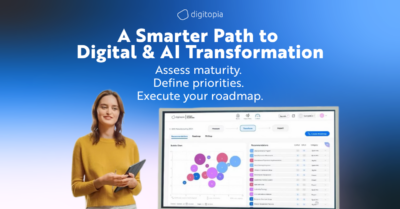
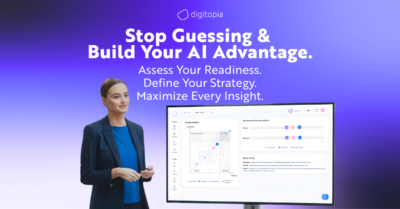
Digitopia’s Digital Maturity and AI Maturity measurement solutions are built to prevent this. They help organizations understand where they stand today, identify the most valuable improvement areas, prioritize investments, and track progress over time with a clear link to business outcomes.
This is how you turn AI + 5G from an exciting story into an operational advantage. It is also how you build trust, because measurement creates transparency and accountability.