

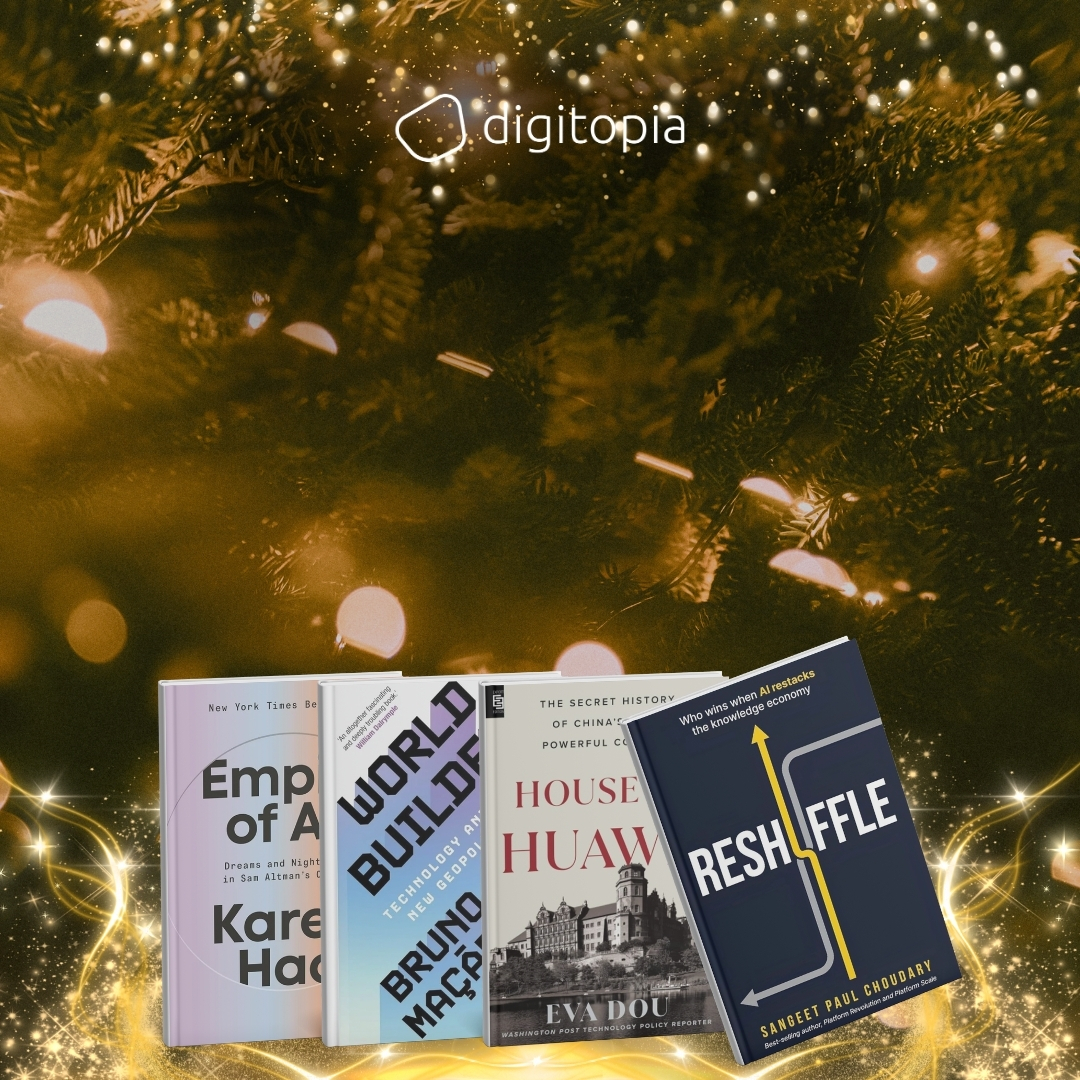
Top 10 Must-Read Business Books for 2025
If you’re leading transformation in 2025, you don’t have time to read everything. This list is curated for senior leaders who care about strategy, AI, culture, and change – and want ideas they can use on Monday morning.




1. Empire of AI: Dreams and Nightmares in Sam Altman’s OpenAI – Karen Hao
Short Summary / Abstract
A deeply reported inside story of OpenAI and Sam Altman, Empire of AI shows how a handful of companies, leaders, and investors are shaping the AI revolution – and how messy, political and human that process really is. It’s as much about power and governance as it is about technology.
About the Author
Karen Hao is an award-winning technology journalist who has covered AI for MIT Technology Review and major outlets before writing this book, giving her unique access to researchers, executives and critics alike.
Why Important to Read?
If you’re making AI bets, you’re implicitly betting on ecosystems, regulators and power structures. This book helps you see the game behind the game – what motivates the key players, how safety and speed collide, and how quickly narratives can shift.
Key Transformation Takeaway
Don’t just adopt AI tools – adopt an AI governance stance.
Build explicit principles for risk, transparency and accountability, or you will end up outsourcing those choices to vendors and regulators.
Learn More: Empire of AI: Dreams and Nightmares in Sam Altman’s OpenAI
2. Reshuffle: Who Wins When AI Restacks the Knowledge Economy – Sangeet Paul Choudary
Short Summary / Abstract
Reshuffle argues that AI’s real power is coordination, not just automation. It shows how AI “restacks” the knowledge economy: breaking jobs into tasks, rearranging workflows, and shifting power between workers, firms and platforms.
About the Author
Sangeet Paul Choudary is a globally known strategist on platforms and ecosystems (author of Platform Revolution, advisor to large enterprises and regulators). He brings a systems lens to AI – structures, incentives, and flows – not just algorithms.
Medium
Why Important to Read?
If your work is about operating models and digital maturity, this book is almost a blueprint. It explains how AI changes who coordinates what, and where value and margin migrate as workflows get modularized and platformised.
Key Transformation Takeaway
Design your operating model for “AI-augmented coordination.”
Don’t just ask “which tasks can we automate?” Ask: “How should we redesign teams, roles, and platforms so that humans and AI coordinate work better than either could alone?”
Learn more: Reshuffle: Who Wins When AI Restacks the Knowledge Economy
3. The Thinking Machine: Jensen Huang, Nvidia, and the World’s Most Coveted Microchip – Stephen Witt
Short Summary / Abstract
This is the story of how Nvidia went from a gaming-GPU company to the central infrastructure provider of the AI boom, powered by Jensen Huang’s decades-long bet on parallel computing and AI.
About the Author
Stephen Witt is a journalist and author known for his investigative, narrative-driven business writing. Here, he combines corporate history, technology, and leadership biography.
Why Important to Read?
Transformation leaders often underestimate infrastructure dependencies. This book shows how one company’s strategic conviction, ecosystem building and control of a chokepoint (high-end chips) can shape what’s possible for everyone else.
Key Transformation Takeaway
Treat infrastructure choices as strategic bets, not IT plumbing.
Cloud, chips, data platforms – these decisions define your speed, cost, flexibility and bargaining power in the AI era.
Learn More: The Thinking Machine: Jensen Huang, Nvidia, and the World’s Most Coveted Microchip
4. How Progress Ends: Technology, Innovation, and the Fate of Nations – Carl Benedikt Frey
Short Summary / Abstract
Frey challenges the idea that technological and economic progress is automatic. Using history, he shows how innovation can stall when institutions, politics, or vested interests block change – and what this means for today’s AI wave.
About the Author
Carl Benedikt Frey is an economist at Oxford, known for his work on technology and the future of work. His research on automation risk is widely cited in policy and business debates.
ig.ft.com
Why Important to Read?
It gives you a macro lens on transformation: why some countries and companies unlock new waves of growth, while others get stuck in bureaucracy and protectionism. It’s a sober counterweight to “AI will fix everything” optimism.
Key Transformation Takeaway
Transformation is institutional as much as technological.
Upgrading tools is easy; upgrading incentives, regulations, and management practices is hard – but that’s where long-term advantage lives.
Learn More: How Progress Ends: Technology, Innovation, and the Fate of Nations
5. World Builders: Technology and the New Geopolitics – Bruno Maçães
Short Summary / Abstract
Maçães argues that great powers are no longer just competing for territory; they are “building worlds” – technological, legal and economic stacks in which others must live. Think platforms, standards, data spaces, and infrastructure, not just borders.
About the Author
Bruno Maçães is a former Portuguese Europe minister and a geopolitical thinker who has written extensively on China, Europe and the digital future.
Why Important to Read?
Transformation doesn’t happen in a vacuum. This book helps you situate your organisation inside larger tech blocs and regulatory worlds – US, EU, China and others – each with its own rules and opportunities.
Key Transformation Takeaway
Choose which “world” you want your business to live in – then design for it.
Data localisation, AI rules, cybersecurity, cloud partners: treat them as elements of a deliberate geopolitical positioning, not ad-hoc IT decisions.
Learn More: World Builders: Technology and the New Geopolitics
6. House of Huawei: The Secret History of China’s Most Powerful Company – Eva Dou
Short Summary / Abstract
House of Huawei tells the story of Huawei’s rise from a small Shenzhen company to a global telecom and tech giant, and its role at the centre of US-China tensions over security, 5G, and now AI and cloud.
About the Author
Eva Dou is a technology reporter for The Washington Post and formerly The Wall Street Journal, with years of on-the-ground reporting in China’s tech sector.
Why Important to Read?
It’s a case study in strategy under geopolitical constraint: sanctions, supply-chain shocks, and political pressure – and how a company adapts, restructures and doubles down on R&D to survive.
Key Transformation Takeaway
Build resilience into your transformation architecture.
Assume shocks: regulation, supply chain, politics, new competitors. Design product portfolios, data strategies and partnerships that can flex under pressure.
Learn More: House of Huawei: The Secret History of China’s Most Powerful Company
7. Breakneck: China’s Quest to Engineer the Future – Dan Wang
Short Summary / Abstract
Dan Wang contrasts a China run by engineers with a US run by lawyers, showing how that shapes infrastructure, manufacturing, and the speed of execution. The book unpacks why China can build certain things faster – factories, rail, EV capacity – and what that implies for the global economy.
About the Author
Wang is a well-known technology and industry analyst, famous for his annual letters on China’s manufacturing and innovation system; this book extends those ideas into a full narrative.
Why Important to Read?
It’s a powerful reminder that execution capability is a strategic asset. For anyone in manufacturing, supply-chain-heavy industries, or industrial digitalisation, this is essential context.
Key Transformation Takeaway
Treat engineering and operational excellence as core strategic functions.
Digital transformation should be anchored in “build and ship” capabilities, not only in PowerPoint strategies and legal/compliance debates.
Learn More: Breakneck: China’s Quest to Engineer the Future
8. Click: How to Make What People Want – Jake Knapp & John Zeratsky
Short Summary / Abstract
From the creators of the Google Design Sprint, Click introduces the “Foundation Sprint” – a structured two-day way to start any big project right: clarify the problem, align stakeholders, define success, and make fast, testable decisions.
About the Authors
Jake Knapp and John Zeratsky are designers and investors who have worked on hundreds of products at Google, GV and beyond. Their earlier book Sprint became a standard in design and innovation circles.
Why Important to Read?
This is a practical execution manual. You can plug Foundation Sprints directly into your transformation portfolio to reduce wasteful projects, endless steering committees and misaligned initiatives.
Key Transformation Takeaway
Start every major transformation initiative with a short, intense “alignment sprint.”
Clarify customer, problem, constraints and success metrics up front – before you commit big budget or promise big outcomes.
Learn More: Click: How to Make What People Want
9. Today Was Fun: A Book About Work (Seriously) – Bree Groff
Short Summary / Abstract
Groff argues that “professional” does not have to mean exhausted, joyless, and over-controlled. Today Was Fun offers rules and practices to redesign work for joy, humanity and meaning in a post-burnout era.
About the Author
Bree Groff is a transformation consultant and speaker who has led change programmes for major companies; she brings both research and war stories from the field.
Why Important to Read?
Transformation fails when people are exhausted, cynical or scared. This book gives you language and tools to make joy and psychological safety part of your operating model, not just wellbeing posters.
Key Transformation Takeaway
Design rituals that make change feel energising, not depleting.
Small things – how meetings start, how wins are celebrated, how people experiment – can turn a transformation from “another burden” into “our shared adventure.”
Learn More: Today Was Fun: A Book About Work (Seriously)
10. Make Work Fair: Data-Driven Design for Real Results – Iris Bohnet & Siri Chilazi
Short Summary / Abstract
Make Work Fair is a behavioural-science playbook for building fairness into systems – hiring, promotion, pay, performance reviews – using data and evidence rather than slogans.
About the Authors
Iris Bohnet is a behavioural economist at Harvard Kennedy School and author of What Works; Siri Chilazi is a gender and organisations researcher and practitioner. They combine rigorous research with corporate practice.
Why Important to Read?
Any serious transformation eventually touches who gets what opportunity. This book shows how to redesign processes so inclusion and fairness are baked in – reducing bias, increasing trust, and improving decision quality.
Key Transformation Takeaway
Audit and redesign your people processes as seriously as your tech stack.
If promotions, pay, and recognition stay opaque and biased, no amount of digital or AI investment will fix culture.
Learn More: Make Work Fair: Data-Driven Design For Real Results