

From 1.9 to 4.2: Why Transformation Maturity Separates Laggards, Competitors, and Leaders
Transformation maturity is becoming a defining factor of future competitiveness. While fragmented companies remain trapped in manual work and disconnected operations, more advanced organizations create compounding advantages through integrated systems, intelligent decision-making, and enterprise-wide alignment. The leaders who can turn transformation into measurable business value are increasingly becoming the ones shaping the future of the company.



There is a sentence executives love to use when the company knows it is behind:
“We’re on a transformation journey.”
Maybe. But in many organizations, that sentence has become a polite way of saying something much less comfortable:
The business is fragmented. Processes rely too much on individual effort. Data is scattered. AI initiatives exist, but the foundation underneath them is weak. Leadership hopes the market will wait long enough for the company to catch up.
It will not.
That is why transformation maturity matters from the beginning. Digital transformation and AI transformation cannot be managed through scattered projects, isolated dashboards, or annual strategy workshops. They need a measurable maturity framework that shows where the business actually stands, where the gaps are, and what should move first.
This is where DAIMI, Digitopia’s Digital and AI Maturity Index, becomes essential.
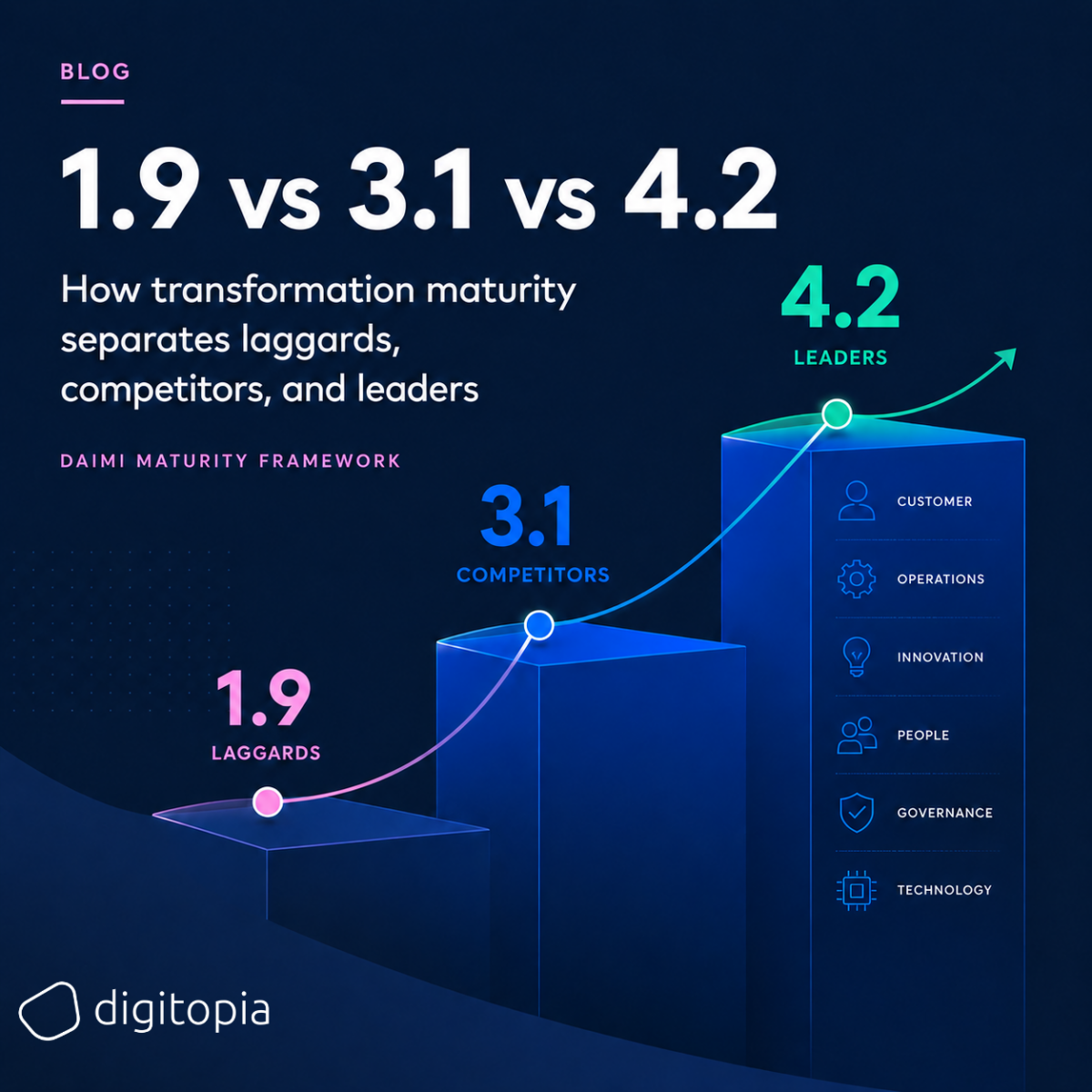
DAIMI measures an organization across six dimensions that shape future competitiveness: Customer, Operations, Innovation, People, Governance, and Technology. Together, these dimensions show whether a company is truly becoming more mature, or simply getting busier.
The difference between a DAIMI score of 1.9, 3.1, and 4.2 is not academic. It is the difference between a company still held together by manual work and institutional memory, a company that has become competent enough to compete, and a company already pulling away from the market.
A company at 1.9 remains in late Beginner territory. It may have visible activity, some tools, and leadership attention, but the operating model is still fragmented. Customer capability may be working at a basic level, operations may be defined on paper, innovation may be attempted through pilots, people maturity may depend on local habits, governance may only be planned, and technology may support daily operations without enabling true transformation.
A company at 3.1 has entered early Integrated maturity. Customer journeys are becoming more coherent, operations and technology are more connected, innovation is more structured, people are more capable across functions, and governance begins to align with execution. This company can finally turn systems, data, and digital initiatives into repeatable value.
A company at 4.2 has reached early Optimized maturity. It is no longer simply implementing digital tools. It is redesigning the enterprise around intelligence, speed, accountability, and compounding advantage.
That divide matters.
Companies below 2.0 are not just behind. They are exposed.
Companies around 3.0 are stronger, but still vulnerable.
Companies above 4.0 are becoming structurally different.
The 1.9 Company: Busy, Proud, and in Trouble
A company with a DAIMI score of 1.9 should not describe itself as “early in the journey.” That language makes the situation sound safer than it is.
Imagine a mid-size consumer goods company in the United States. The company still sells. The brand is known. Retail relationships exist. The leadership team works hard. None of that means the business is prepared for the future.
In fact, hard work may be hiding the problem.
Customer data lives across teams, files, distributors, spreadsheets, inboxes, and disconnected systems. There may be a CRM pilot, a helpdesk tool in one department, some e-commerce reporting, and a few dashboards built by motivated employees. But the company does not have a coherent customer system.
Operations show the same pattern. Forecasting is inconsistent. Supply planning depends on people who “just know how things work.” Exception handling becomes the daily workflow. Teams spend their time chasing updates, correcting files, forwarding emails, and escalating problems that should have been prevented by design.
The language inside the company reveals the operating model:
“Can somebody follow up?”
“Who owns this?”
“Let’s fix it manually for now.”
“We need an urgent workaround.”
“Did anyone update the file?”
“Can we escalate?”
This is not operational discipline. It is normalized firefighting.
At 1.9, customer maturity remains mostly basic. The company may collect some customer data, run occasional surveys, or tag accounts manually, but customers still experience inconsistent service, repeated friction, and disconnected channels.
Operations may be documented in places, but they remain manual and siloed. KPIs exist, yet they do not always drive better decisions. Ticketing may have started, but the business still depends on workarounds.
Innovation is not yet a managed capability. Ideas appear, pilots happen, and people experiment, but there is no portfolio discipline, no clear scaling logic, and no reliable learning transfer from one initiative to the next.
People maturity is also limited. Training may exist for selected roles, but behavior is still shaped by hierarchy, habit, and local routines. Governance has begun on paper, but ownership, metrics, controls, and decision rights have not yet become a functioning enterprise model.
Technology keeps the company running. It does not yet help the company transform.
This type of organization says it wants AI while struggling to trust its own data. It wants automation while key processes still depend on email. It wants growth while the operating model leaks time, margin, attention, and talent every day.
A company at 1.9 does not only have inefficiency. It has weak future economics.
That matters because the next few years will punish slow maturity. A business like this may continue to generate revenue. It may have profitable pockets. It may even look stable from the outside. But without serious transformation management, it will struggle to shape the future of its category.
Some companies in this position will be acquired. Some will be margin-compressed into irrelevance. Some will lose talent to faster organizations. Some will survive, but only as weaker versions of what they could have become.
The market does not care how sincere your transformation language sounds. It cares whether your maturity is high enough to compete.
Jennifer: The CIO Who Refused to Stay in the IT Box
This is where Jennifer enters the story.
Jennifer was the CIO of a consumer goods company very much like the one above. The company was not a disaster. It was not a startup. It was not a headline brand. It was a decent mid-size business with decent people and a competitive position that was slowly decaying.
For years, Jennifer was treated as the executive responsible for systems, stability, budgets, vendors, and security. When something broke, she was expected to fix it. When leadership discussed transformation, she was expected to “support the business.”
That role was too small for the problem.
Jennifer could see that the company did not have a technology problem alone. It had a maturity problem. The breakdown was spread across Customer, Operations, Innovation, People, Governance, and Technology at the same time.
She used DAIMI as a way to make denial visible.
Once the company saw its actual digital and AI maturity profile, the conversation changed. The question was no longer, “Do we need another system?” The question became, “Why are we still operating as disconnected teams while pretending to be one enterprise?”
That was the turning point.
Jennifer stepped beyond the narrow CIO lane and began acting as the company’s Chief Transformation Officer before anyone gave her the title.
She built a Transformation Management Office, but not a PMO with better slides. This was an enterprise mechanism for prioritization, dependency management, value tracking, operating model change, and executive accountability.
The TMO sat at the center of the business. It connected customer pain points to process redesign. It connected process redesign to data and platform choices. It tied investment decisions to measurable maturity movement. It forced governance conversations that had been avoided for years.
Some leaders resisted it at first.
The TMO exposed pet projects. It challenged local autonomy. It surfaced weak ownership. It made vague ambition visible as hard trade-offs. That is what transformation management does when it works properly. It removes the comfort of ambiguity.
Jennifer’s credibility rose because she stopped speaking only in technology language. She began speaking in business value, sequencing, capability building, leadership behavior, and competitive risk.
The board eventually saw what had changed.
She was no longer the executive who ran IT. She had become the executive who could move the enterprise.
That is why the path from CIO to Chief Transformation Officer is becoming one of the most powerful career moves in modern business. The executive who can align AI, digital, process, talent, governance, and value creation becomes much more than an operator. That person becomes a serious contender for the top job.
Jennifer eventually became CEO.
Not because the title was handed to her as a reward, but because she had already become the leader the company was following. By the time the promotion became official, it simply confirmed what was already true in practice.
She understood how the business had to change. She knew how to make it change. And she could turn change into performance.
That is the opportunity in front of many CIOs now.
They can remain guardians of internal technology, or they can become architects of enterprise reinvention.
The 3.1 Company: Stronger, Smarter, but Not Yet Safe
Now consider a European EV manufacturer with a DAIMI score of 3.1.
This business is in a very different position. It has moved beyond basic fragmentation and entered early Integrated maturity. That changes the conversation.
Customer capability is becoming more satisfying. Identity resolution works well enough to support a usable customer view. Handoffs across channels are improving. Customers repeat themselves less. Service becomes proactive in selected journeys. Next-best-action logic begins to influence commercial and service decisions.
Operations are also becoming more integrated. Planning, sourcing, production, logistics, and service are increasingly connected. Shared KPIs guide trade-offs. Data becomes useful for action, not just reporting.
Innovation becomes more structured. Cross-functional squads ship meaningful work. Funding decisions follow evidence more than internal politics. AI initiatives become narrower, more useful, and more connected to business value.
People maturity improves as well. Teams develop broader capabilities. Collaboration becomes less painful. The organization can execute across boundaries without turning every handoff into a negotiation.
Governance becomes more aligned. Strategy, OKRs, controls, data governance, and delivery reviews begin to reinforce each other. Technology architecture becomes more integrated through APIs, reusable services, and stronger platform logic.
This is the stage where leadership starts to feel good. And they should. The business is stronger. It can see its workflows more clearly. It can prioritize more rationally. It can make investments that have a better chance of sticking.
But the danger at 3.1 is self-congratulation.
A company at this level is strong enough to compete. It has not yet built enough maturity to dominate.
That distinction matters.
The EV manufacturer may survive. It may perform well. It may gain market share. But unless it keeps climbing, it risks becoming a competent participant in a future defined by someone else.
This is why continuous DAIMI measurement matters at mid-maturity. Without measurement, transformation programs can drift into comfortable reporting. With measurement, leadership can see whether progress is substantial, where integration remains shallow, where AI is still ornamental, and where the enterprise is still underbuilt for the future.
A company at 3.1 has earned credibility.
It has not earned inevitability.
The 4.2 Company: Redesigning the Enterprise Around Intelligence
Now consider a European industrial manufacturer with a DAIMI score of 4.2.
This company has moved into a different category.
Customer maturity is becoming attractive. Real-time signals support personalization in priority journeys. Predictive models improve service and commercial decisions. Closed-loop experimentation changes how the company operates, learns, and grows.
Operations are optimized. Predictive analytics improve inventory, staffing, maintenance, and throughput. Digital twins allow the business to test scenarios before acting. Decisions that once took weeks can now be made in days or hours.
Innovation becomes more ambitious and disciplined at the same time. Experimentation happens at scale. GenAI accelerates research, prototyping, documentation, and design. Portfolio choices become clearer because leadership has better evidence, stronger governance, and sharper prioritization.
People maturity becomes agile. GenAI copilots support a wider range of roles. Leadership uses skills, outcomes, and operating data to redesign how work gets done. The organization stops treating job descriptions as fixed containers and begins treating capability as dynamic.
Governance becomes effective. Controls are embedded into delivery pipelines. Approvals, testing, logging, monitoring, and rollback become more automated. Compliance creates less friction because it is built into the operating model rather than added at the end.
Technology becomes strong: scalable, resilient, cost-aware, and capable of supporting fast iteration without collapsing under its own complexity.
But the defining feature of a 4.2 company is leadership courage.
This company understands that transformation cannot live as a side program. It cannot sit inside an innovation lab. It cannot be reduced to a digital workstream. Transformation becomes the redesign of the enterprise around intelligence, speed, accountability, and learning.
The top leadership team leads from the front. They communicate the transformation agenda. They force hard decisions. They model adoption. They challenge old structures. They invest in upskilling. They reward experimentation. They remove blockers.
This is where the maturity gap widens fast.
A company at 4.2 compounds. Better data improves decisions. Better decisions improve customer outcomes and operational performance. Better performance creates more room for innovation. Better innovation attracts stronger talent. Stronger talent increases adaptability. Then the cycle accelerates.
Meanwhile, the 1.9 company is still escalating spreadsheet errors.
The 3.1 company is still integrating the basics.
The 4.2 company is redesigning the rules of competition.
Why Digital and AI Maturity Will Define the Next Competitive Gap
The hard truth is simple: low-maturity companies will struggle to keep up, mid-maturity companies may survive without shaping the future, and advanced-maturity companies will keep pulling away.
That is not drama. It is economics.
The winners will not be the companies with the largest number of AI pilots. They will be the companies with the highest transformation maturity across Customer, Operations, Innovation, People, Governance, and Technology.
AI does not create strategic advantage inside a weak operating model. Automation does not fix broken ownership. Dashboards do not replace governance. A new platform does not create alignment by itself.
Transformation maturity is what turns digital and AI investment into measurable business value.
That is why this is such a pivotal moment for the CIO.
The CIO can remain the guardian of systems, or become the architect of enterprise transformation. This may mean building an AI Center of Excellence where the organization needs intelligent capability at scale. It may mean building a Transformation Management Office where the organization needs sequencing, governance, prioritization, and value tracking. In many companies, it will require both.
The future-ready CIO will not be measured only by uptime, budgets, and vendor performance. They will be measured by their ability to connect technology with strategy, maturity with execution, and transformation with business value.
That is the shift from CIO to Chief Transformation Officer.
And for some leaders, it will become the path to CEO.
Because the executive who can turn fragmented effort into measurable maturity, measurable maturity into business value, and business value into strategic separation is doing more than modernizing the company.
That executive is shaping the company’s future.
The companies that fail to understand this will keep repeating the same comfortable sentence:
“We’re on a transformation journey.”
The market’s answer will be much less polite:
Move faster. Or move aside.