

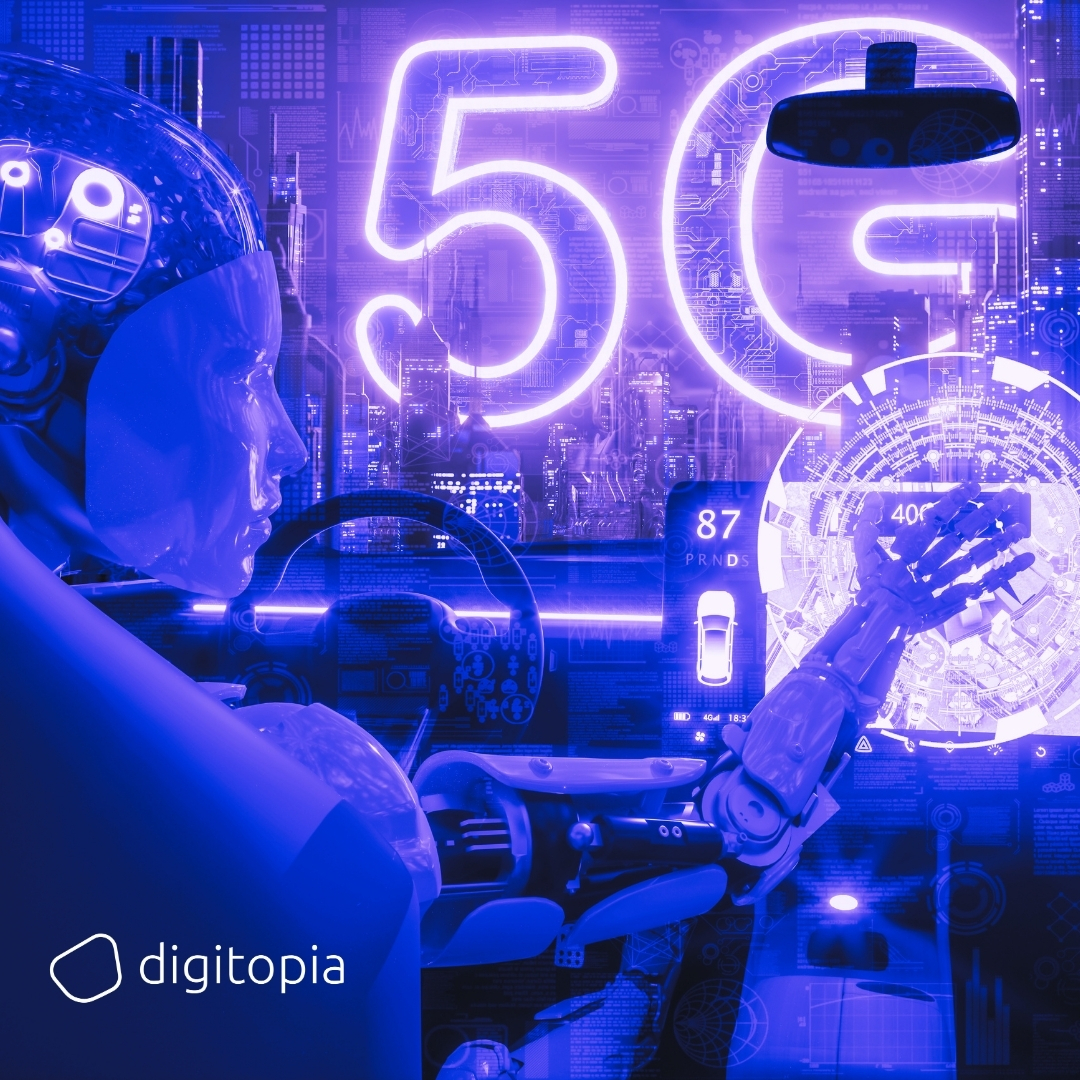
When Intelligence Meets Connectivity: Why AI + 5G Is the Next Inflection Point
The convergence of AI and 5G is turning digital intelligence into real-time action at scale. While AI enables systems to sense, predict, and decide, 5G ensures those decisions can be executed instantly across connected environments. Together, they unlock faster operations, higher reliability, and measurable business outcomes—making AI and 5G a true inflection point for organizations ready to move beyond pilots and into scalable value.



Picture a near-future morning in any major city.
A bus moves through intersections that seem to anticipate its delay and adjust signals in real time. A warehouse receives an urgent medical shipment and autonomous vehicles inside reroute instantly because a sensor detected a safety hazard in the main corridor. In a hospital, an AI assistant monitors intensive-care vitals continuously and flags a subtle risk pattern early enough to prevent escalation. In a factory outside town, a line supervisor says, “reduce scrap on Line 3,” and the system responds by adjusting machine parameters, validating quality through computer vision, and documenting the change for compliance.
None of this requires science fiction. The building blocks already exist. What is changing is our ability to connect perception, decision, and action at scale, fast enough to matter, reliable enough to trust, and distributed enough to operate across millions of devices and countless micro-moments.
That is the potential of AI meeting 5G. Not simply smarter analytics or faster networks, but a new operating reality where digital intelligence becomes real-time, everywhere, and embedded into the physical world.
For leaders, this creates a practical strategic question. How do we turn the promise into measurable value without getting stuck in pilots and hype? The organizations that win will be the ones that can baseline capabilities, prioritize use cases, and improve maturity systematically, rather than hoping technology alone carries the transformation.
The core idea in one sentence
AI makes systems intelligent. 5G makes that intelligence responsive at scale.
If we strip away the buzzwords, the AI and 5G relationship is straightforward. AI is the brain. It recognizes patterns, predicts outcomes, optimizes decisions, and increasingly automates actions. 5G is the nervous system. It connects sensors, devices, machines, and people with high responsiveness and high capacity, so information moves quickly enough to enable real-time control.
Individually, each technology is valuable. Together, they enable something bigger: closed-loop operations.
Closed-loop operations are the heartbeat of modern performance. A system senses what is happening, interprets it, decides what to do, and acts, then learns from the results. The faster and more reliably that loop runs, the more powerful it becomes. This is why the AI and 5G combination is not a marginal improvement. It changes what is feasible.
What 5G adds beyond faster internet
Most people first encounter 5G as improved speed on their phone. Speed matters, but the deeper change is about how networks behave in the real world.
5G improves responsiveness, meaning systems can react quickly enough for time-sensitive control. It improves capacity, meaning networks can carry many more data streams and device connections simultaneously. It improves consistency and reliability, which makes performance less unpredictable and more suitable for mission-critical environments. It also introduces flexibility, which means networks can be tailored to different needs. For example, one environment may require ultra-reliable performance for industrial automation, while another prioritizes bandwidth for immersive media and video.
When these qualities are applied to business and public services, connectivity stops being a background utility. It becomes a foundation for digital control, continuous sensing, and faster action.
What AI adds beyond chatbots
AI also risks being misunderstood, especially in the public conversation. Many people associate AI primarily with generative tools and chat-based assistants. These are important, but the most transformative AI in business and society is applied AI.
Applied AI is what lets systems perceive the world through sensors and computer vision, predict what is likely to happen next, optimize decisions continuously, and in some cases act autonomously within clear boundaries. It is the difference between having insights and producing outcomes. It is what turns data into safer operations, higher quality, faster service, lower costs, and better customer experiences.
This matters because many organizations already have large amounts of data. The constraint is not only collecting data. The constraint is turning it into timely decisions and consistent action.
Why the combination creates step-change value
When AI meets 5G, the impact is larger than the sum of its parts. The simplest way to understand the value is to look at what becomes possible when the decision loop speeds up and scales out.
First, real-time decision loops become practical across many environments. Many organizations do not fail because they lack data. They fail because they respond too slowly. By the time an issue is recognized, the moment has passed. AI can detect and decide, but it needs a fast and stable way to move information between devices, systems, and people. That is where 5G matters.
Second, intelligence can be deployed closer to where reality happens. Not every decision should travel to a distant cloud and back. In many cases, you want analysis and action near the devices and processes where the data is generated. This is particularly relevant when decisions must happen quickly, when systems need resilience, or when privacy requirements limit where data can go. With advanced connectivity, distributed architectures become easier to operate, and AI can be deployed where it creates immediate operational advantage.
Third, scale creates learning. As more devices connect and more operational signals become visible, AI models can improve more rapidly and become more reliable. This creates a compounding effect. Better sensing leads to better models. Better models lead to better decisions. Better decisions lead to better outcomes. Better outcomes justify further investment and adoption. 5G supports the scale and density of connectivity that makes this flywheel possible.
Finally, trust becomes easier to build. Automation only becomes strategically meaningful when leaders trust it enough to place it in mission-critical workflows. Reliability and predictability in connectivity are important for that trust. When systems behave consistently, organizations are more willing to move from decision support toward partial autonomy.
Where the business value actually shows up
Across industries, the value of AI and 5G tends to concentrate in a few outcome categories that are familiar to any executive audience.
Productivity improves because interruptions, rework, and delays can be detected earlier and corrected faster. Quality improves because defects and process drift can be identified in real time rather than at the end of a line or at the end of a week. Safety improves because hazards can be detected proactively rather than waiting for human vigilance to catch everything. Customer experience improves because services become more responsive, more personalized, and more consistent across touchpoints. Sustainability improves because energy usage, routing, maintenance, and resource consumption can be optimized continuously.
These outcomes translate into what leadership teams ultimately care about: growth, margins, resilience, and the ability to attract and retain talent in a world where people expect modern tools and modern experiences.
It is not just about better operations
A common mistake is to think of AI and 5G purely as operational tools. They also enable business model change.
When you can sense and manage reality in near real time, you can move from selling products to selling outcomes. You can offer “uptime” rather than equipment, “performance” rather than capacity, “availability” rather than ownership. You can provide remote expertise and support across geographies without quality degradation. You can build ecosystems that coordinate across partners because data can move reliably and quickly enough to support shared processes and shared services.
In many industries, competitive advantage increasingly comes from how well a company orchestrates its network of operations and partnerships. AI and 5G make that orchestration more feasible.
What leaders often get wrong
The first misconception is treating 5G as a telecom project. If it is framed as infrastructure alone, it becomes a cost line and a deployment debate. The organizations that get it right treat connectivity as an enabler of operational transformation and business model innovation. That shifts the conversation from “how fast” to “what outcomes.”
The second misconception is believing AI value is automatic once data exists. AI does not create value by existing. It creates value when embedded into workflows, governed responsibly, owned by the business, and measured in terms that matter. Without this, AI becomes a set of disconnected pilots, often impressive in demos and weak in outcomes.
In both cases, the missing element is not technology. The missing element is maturity. It is the ability to integrate technology into processes, decision rights, governance, skills, and change management.
A practical way to begin
The right starting point is not selecting a technology stack. It is selecting moments where real-time intelligence changes outcomes. This typically means focusing on areas where the cost of being late is high and where faster action directly improves performance.
A good way to pick initial targets is to ask a few simple questions.
- Where do we lose money or create risk because we respond too late?
- Which processes are constrained by unreliable or slow connectivity?
- Where do frontline teams need better situational awareness right now?
- Which decisions could become semi-autonomous with clear boundaries?
- Where are quality and safety dependent on human vigilance alone?
From there, select a small number of use cases with clear operational ownership, measurable outcomes, and realistic integration scope. The goal is to prove repeatable value and then scale.
Final recommendation: treat AI + 5G as a maturity journey
The organizations that win will approach AI and 5G as a capability journey that is measured, benchmarked, and improved continuously.
This is why maturity measurement is not a nice-to-have. If you cannot answer “where are we today?” and “what will move the needle next?”, you will overinvest in tools and underinvest in outcomes. You will also struggle to scale beyond pilots because there is no shared baseline and no shared roadmap.
A practical next step is to establish an objective baseline using structured maturity frameworks, then translate that baseline into a prioritized roadmap and a cadence of improvement.
Digitopia’s Digital Maturity and AI Maturity measurement solutions are designed for this exact challenge. They help organizations establish a clear baseline, identify the highest-impact improvement areas, build a realistic roadmap, and track progress and impact over time.
Because in transformation, what gets measured gets done.