

CIO AI Transformation Blog Series – 4.Operational Excellence in the Age of AI
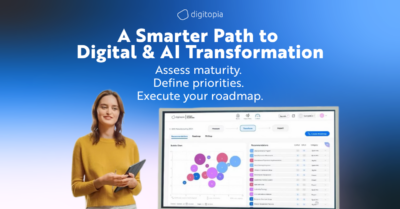
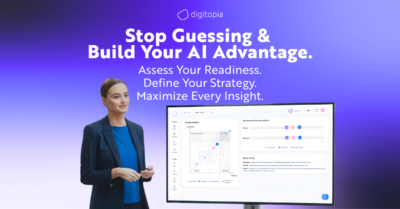
AI is redefining operational excellence from leaner processes and cost control into adaptive, intelligent, and continuously improving operations. CIOs have a central role in this shift because AI-enabled operations depend on systems, data, governance, process design, business ownership, and execution discipline. By using Digitopia’s DAIMI, organizations can assess operational readiness, identify maturity gaps, prioritize high-value AI initiatives, and build a roadmap that turns isolated improvements into scalable enterprise performance.



For years, operational excellence was associated with discipline, standardization, lean processes, cost control, and continuous improvement. Those principles still matter. But in the age of AI, they are no longer enough.
Operational excellence is being redefined.
The old model focused on doing the same work with less waste. The new model focuses on redesigning work itself. AI changes how demand is predicted, how decisions are made, how exceptions are handled, how quality is monitored, how service is delivered, how assets are utilized, and how teams intervene. It allows organizations to move from reactive operations to adaptive operations, from fixed routines to dynamic orchestration, from delayed insight to continuous intelligence.
This is why CIOs must stop framing AI merely as a productivity accelerator.
Yes, AI can improve productivity. But that is too narrow a lens. The real prize is broader: better quality, faster cycle times, lower risk, stronger resilience, improved customer experience, and entirely new levels of operational responsiveness.
Operational excellence in the age of AI is not about automating the existing enterprise. It is about creating a more intelligent one.
That is a major leadership opportunity for CIOs, because operations sit at the convergence of systems, data, processes, people, governance, and execution. In many companies, no other executive is better positioned to help connect those elements into an AI-enabled operational model.
The first step is honesty.
Most organizations do not yet know how ready their operations are for AI-enabled redesign. Some functions may have excellent data and mature workflows. Others may still rely on fragmented systems, poor process visibility, limited standardization, and weak ownership. Some leaders may want predictive planning while teams still struggle to trust basic dashboards. Some organizations may be eager to automate while their exception handling, governance, or quality controls remain immature.
That is why the conversation must start with measurement.
You can’t manage what you can’t measure. Before the company can pursue AI-powered operational excellence, it must assess where it stands across the maturity dimensions that make such progress possible. Digitopia’s DAIMI gives CIOs a structured way to do this.
In the early phase, DAIMI helps leaders understand not only the general maturity of the organization, but specifically the readiness of its operating environment for AI. Are the foundations in place? Is there clarity on priorities? Does the organization have the governance, skills, delivery capacity, and business ownership required to redesign operations successfully? Where are the real bottlenecks?
This matters because AI applied to operations without readiness often produces disappointing results. Companies accelerate bad workflows. They automate inconsistency. They move faster without improving quality. They create isolated wins without systemic value. They underestimate the human and organizational change required.
A rigorous assessment prevents that.
Once the current state is visible, the CIO’s role becomes strategic. The second phase is to move from maturity insight to operational transformation roadmap.
This is where DAIMI belongs in the middle of the article and in the middle of the enterprise agenda. Its value is not limited to diagnosis. It helps leadership prioritize where AI can create the greatest operational leverage.
Operational excellence in the AI era should be built around a few strategic principles.
First, lead with quality, not speed alone. Faster decisions, faster code, faster service, or faster workflows are not a win if quality deteriorates. In fact, one of the most dangerous mistakes enterprises make is becoming faster at producing lower-value outcomes.
Second, align operations with the business outcomes that matter most. Revenue growth, customer retention, cost efficiency, asset utilization, cycle-time reduction, regulatory confidence, and resilience all matter more than generic activity metrics.
Third, think in systems, not isolated use cases. AI creates the most value when embedded into workflows, platforms, and decision loops rather than scattered as standalone experiments.
Fourth, redesign the operating model, not just the task list. That means reviewing ownership, handoffs, escalation paths, performance metrics, and the human-machine division of labor.
A roadmap built from DAIMI findings can help leadership decide where to focus operational transformation first.
This year, CIOs should identify a portfolio of high-value operational domains where AI can make a meaningful difference. These may include customer service, supply chain, maintenance, planning, field operations, quality assurance, IT operations, procurement, or internal support functions. The goal is not to launch dozens of pilots. It is to choose a manageable set of initiatives that matter strategically and can build reusable capability.
At the same time, leaders should define what success means. That includes not only expected gains in speed or cost, but also improvements in quality, risk, customer experience, or exception reduction. This year is about establishing credible proof, disciplined scope, and the foundations of repeatability.
By 2027 and 2028, operational excellence should shift from point improvements to scaled redesign. AI should be integrated into workflows, decision points, and planning mechanisms. Teams should increasingly work with predictive and prescriptive support. Managers should be reviewing operational patterns, not just incident reports. Processes should begin to adapt in near real time rather than waiting for periodic reviews.
By 2030, operational excellence should look fundamentally different. Leading organizations will run with a more fluid combination of humans, automation, analytics, and intelligent agents. They will detect issues sooner, allocate resources more intelligently, and reconfigure workflows more quickly. Their operations will not only be leaner; they will be more adaptive and more strategic.
But none of this happens without execution discipline.
This is where the third DAIMI embed becomes critical. Many operational initiatives die in the valley between pilot success and scaled adoption. They fail because governance is weak, ownership is fragmented, priorities shift, or change management is underestimated.
CIOs must therefore treat AI-enabled operational excellence as a transformation program with a management system behind it. DAIMI helps provide that structure by supporting reassessment, governance reviews, and progress tracking.
Quarterly business reviews should monitor both business outcomes and maturity indicators. Are operational teams adopting the new ways of working? Are process owners aligned? Are exceptions declining? Is quality improving? Are teams building reusable capability? Where is the friction? What must change in the roadmap?
Annual reassessment should refresh the baseline and allow leadership to determine whether operational maturity is advancing, not just whether individual use cases are performing.
This matters because operational excellence is no longer simply about internal efficiency. It is now directly connected to competitive advantage.
Companies that redesign operations intelligently with AI will serve customers better, respond faster, utilize assets more effectively, reduce waste more systematically, and free talent for higher-value work. Those that hesitate will remain slower, more brittle, and less adaptive.
For CIOs, this is a chance to expand their relevance beyond systems and into business performance.
Operational excellence in the age of AI is not a narrow IT agenda. It is an enterprise performance agenda.
And the CIO who helps redesign how the business operates will become one of the central architects of enterprise value creation in the years ahead.
That is the real opportunity.
Do not just automate operations.
Reinvent them.