

CIO AI Transformation Blog Series – 8.Leadership in the Age of AI: How CIOs Drive Enterprise Transformation
AI-era leadership demands more than technology adoption. CIOs must guide enterprise reinvention by connecting AI maturity, strategic prioritization, roadmap discipline, governance, human trust, and execution cadence. Digitopia’s DAIMI helps leaders understand current maturity, identify capability gaps, align stakeholders, prioritize initiatives, and track progress over time, turning AI transformation from scattered ambition into structured, measurable enterprise change.



Leadership is being rewritten.
Not in the simplistic sense that AI will replace leaders. It will not. But in the more important sense that the demands placed on leaders are changing fundamentally. The assumptions that defined effective leadership in the previous era are no longer sufficient for the one now emerging.
The Age of AI requires leaders who can manage ambiguity, orchestrate human and machine capability, rethink decision-making, align fast-moving portfolios, redesign organizations, and keep the enterprise grounded in both value and responsibility.
In short, it requires a new leadership model.
This matters for every executive, but especially for CIOs. Because the CIO now stands at the intersection of technology possibility, business reinvention, operating-model redesign, and enterprise execution.
The CIO who understands leadership in the Age of AI will not merely support the future. They will help define it.
What does that leadership look like?
First, it is more strategic than technical.
This may sound surprising in an article for CIOs, but it is essential. The AI era does not reward leaders who know the most about tools. It rewards those who can connect AI to enterprise value, competitive position, workforce evolution, and long-term reinvention. Leaders must ask not just what AI can do, but what the enterprise should become because AI now exists.
Second, it is more systemic than local.
AI creates cross-functional consequences. It affects products, services, operations, governance, talent, customer expectations, and business models simultaneously. Leaders who optimize one function without seeing the broader system will create fragmentation.
Third, it is more adaptive than static.
The pace of AI evolution means leaders cannot rely on rigid multi-year plans disconnected from learning. They need direction, yes, but also feedback loops, review cadences, and the humility to adjust.
Fourth, it is more human than ever.
Paradoxically, as machine capability rises, the importance of human trust, judgment, meaning, communication, and change leadership rises as well. Employees and customers will not simply judge leaders on how much AI they deploy. They will judge them on how wisely, transparently, and effectively they lead through change.
This is why leadership in the Age of AI must begin with clarity, not noise.
And that is where the first DAIMI embed belongs.
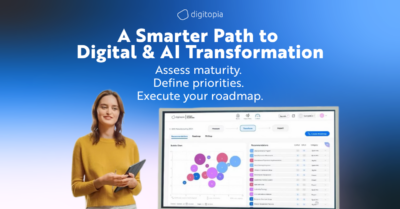
A leader cannot guide the enterprise through transformation if they do not understand its current maturity. You can’t manage what you can’t measure. Digitopia’s DAIMI gives leaders a structured way to see where the enterprise truly stands across the dimensions that matter for AI success. It supports honest leadership.
That honesty is powerful. It prevents performative ambition. It reveals hidden weaknesses. It surfaces asymmetries between executive intention and organizational capability. It gives leadership a language for discussing readiness, governance, skills, priorities, and execution.
In the Age of AI, one of the leader’s first duties is to create a shared reality. DAIMI helps do that.
But leadership is not only about understanding the present. It is about shaping the future.
This is where the second DAIMI embed comes in: strategy, priorities, and roadmap.
Leadership today means making choices under uncertainty. There will always be too many AI ideas, too many vendor promises, too many possible pilots, too many competing demands. The leader’s job is not to say yes to everything. It is to decide what matters most, sequence it intelligently, and align the enterprise behind that path.
A leader in the Age of AI must therefore ask better questions.
Which strategic priorities matter most? Where can AI create distinctive value rather than generic efficiency? Which parts of the business model are likely to change? Which capabilities must be strengthened now to compete by 2030? What operating-model changes are necessary? Which risks deserve more attention? Which opportunities deserve more courage?
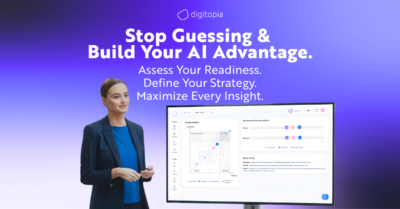
DAIMI supports this form of leadership by helping convert assessment into roadmap. It enables sharper prioritization. It allows leaders to connect maturity gaps to strategic action. It turns transformation into a sequence rather than a slogan.
That roadmap should again span three horizons.
This year, leaders must establish clarity. Assess the enterprise. Align the top team. Define the AI ambition. Prioritize the first major workstreams. Clarify governance and ownership. Build momentum with discipline, not hype.
By 2027 and 2028, leaders must manage integration. AI should be moving from pilots into the core of the enterprise. Workflows, teams, roles, decision models, and management systems should begin to change. Leadership in this phase means maintaining focus while navigating complexity.
By 2030, leaders must have created a company that does not merely use AI, but competes differently because of it. The best leaders will have reshaped the enterprise’s ability to learn, adapt, and create value continuously.
But perhaps the most defining mark of leadership in the Age of AI is execution.
It is easy to appear visionary in times of technological excitement. It is much harder to build cadence, accountability, trust, and progress over years of change.
This is where the third DAIMI embed becomes crucial. Leadership must be made operational. Reassessment, review, feedback, and steering must be built into the enterprise rhythm.
Quarterly leadership reviews should monitor not only initiatives and budgets, but maturity progress, workforce readiness, business engagement, governance quality, and execution barriers. Annual reassessment should challenge complacency and refresh priorities. Leaders should insist on visible learning, not just visible activity.
This is what mature AI leadership looks like. It is neither reactive nor theatrical. It is structured, adaptive, and grounded.
It also requires a new mindset toward power and control.
Traditional leadership often assumed that information flowed upward, decisions flowed downward, and execution happened in between. AI changes that. Knowledge becomes more distributed. Experimentation emerges from multiple corners. Decision support becomes more dynamic. The leader’s role shifts from controlling every move to designing the system in which good moves become more likely.
That is why leadership in the Age of AI is less about command and more about orchestration.
Leaders must create direction without rigidity. Guardrails without paralysis. Trust without naivety. Speed without chaos. Learning without drift.
For CIOs, this is a defining test.
The CIO who understands leadership this way will do more than modernize the enterprise. They will influence how the organization thinks, decides, and evolves.
And that may be the deepest truth of all.
AI is not only changing how work is done.
It is changing what leadership is for.
The leaders who thrive will not be those who simply adopt the newest technology fastest.
They will be those who can help the enterprise become wiser, more adaptive, more aligned, and more capable in a world where intelligence is no longer exclusively human.
That is leadership in the Age of AI.
And it starts now.