

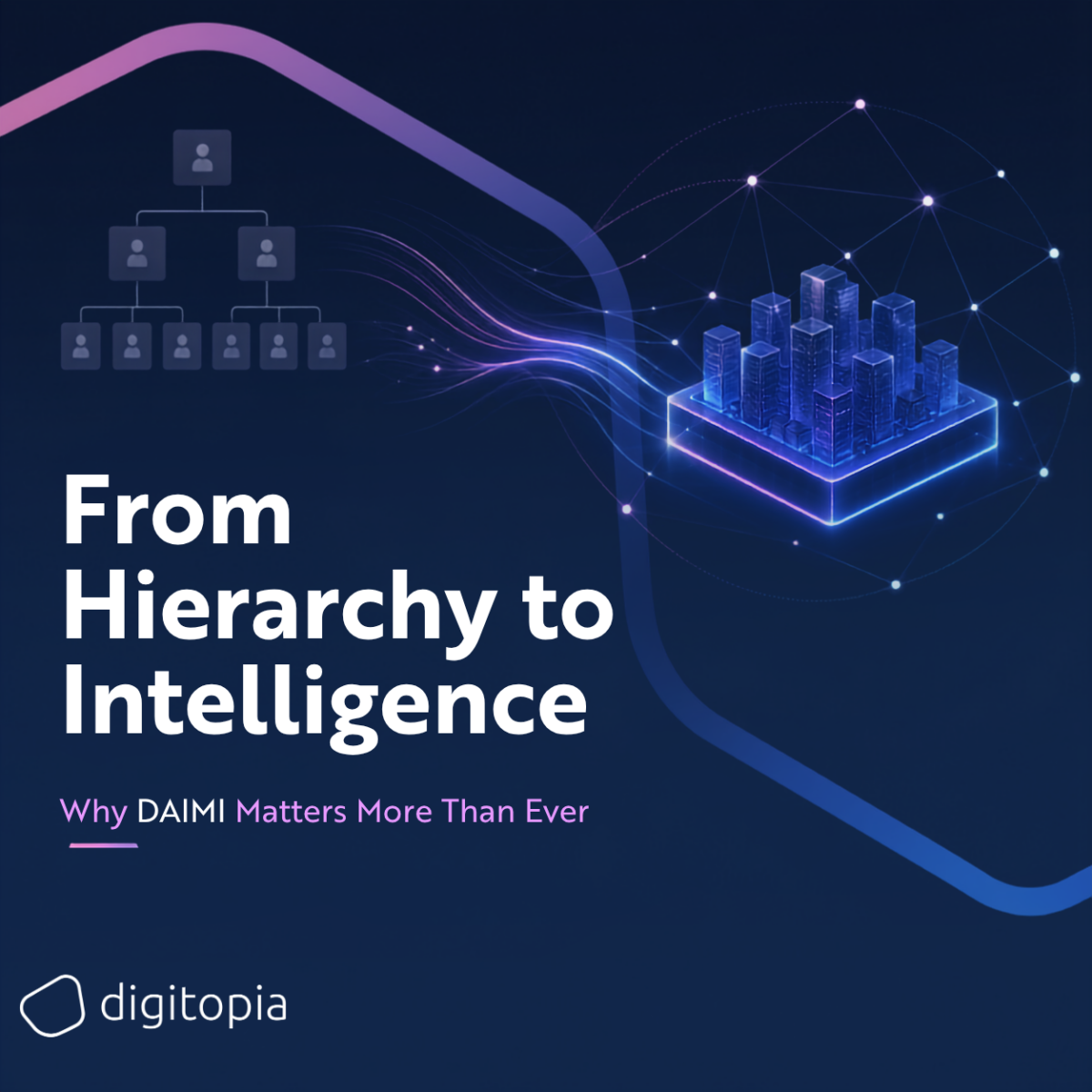
From Hierarchy to Intelligence: Why DAIMI Matters More Than Ever
The next shift in organizational design replaces hierarchy with intelligence as the main coordination mechanism, turning the enterprise into a living model of itself. Most companies cannot make that leap directly, because applying AI on top of fragmented data and siloed teams scales confusion instead of creating intelligence. DAIMI provides the missing bridge. It helps leadership see the business as one system, set explicit priorities, generate ideas from a shared fact base, translate ambition into a sequenced roadmap, and steer execution with rhythm and discipline. The intelligent organization begins with an enterprise that understands itself, and adaptation is becoming a designed capability rather than a cultural trait.



The intelligent organization is the next great shift in organizational design. A recent Sequoia essay makes the case: it is not another reshuffling of boxes on an org chart. It is a move from hierarchy as the main coordination mechanism to intelligence as the main coordination mechanism. In that vision, AI does not simply make today’s structure a bit more efficient. It helps the company build a living model of itself: its capabilities, customers, transactions, constraints, priorities, and opportunities.
What is being described is the organizational evolution of a digital twin. Not a digital twin of a machine or a production line, but of the enterprise itself. A representation of how the business actually works, where value is created, where friction accumulates, where customers are signaling change, and where decisions should be made faster and better.
This vision is exciting. It also raises a very practical question.
How does a company get there?
Most organizations cannot jump straight from fragmented data, siloed teams, unclear priorities, and inconsistent execution into becoming a fluid, intelligent organism. If you apply AI on top of confusion, you do not create intelligence. You scale confusion.
That is why digital and AI transformation are becoming even more important. They are no longer optional modernization programs. They are the baseline capabilities required for a company to become adaptive, coordinated, and truly intelligent.
This is exactly where DAIMI becomes so relevant.
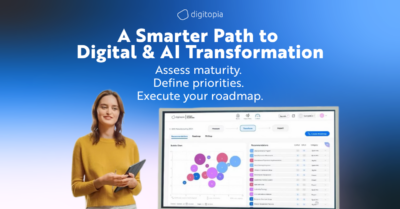
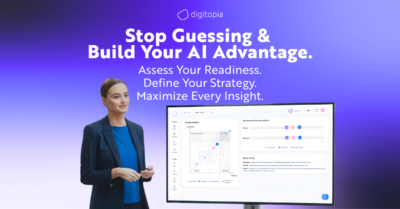
DAIMI is not just a maturity assessment. Used properly, it becomes a management instrument for organizational evolution. It helps leadership look holistically at the entirety of the business, establish a shared fact base, identify what matters most, stimulate new thinking, define strategy and roadmap, and make execution smoother and more effective. That is the bridge between ambition and transformation.
The Intelligent Organization Starts With Seeing Itself as a System
This is more important than it sounds. Many leadership teams operate with partial truths. Each function sees its own priorities. Each team has its own language. Each initiative has its own logic. The result is often motion without coherence.
DAIMI creates a common view. It turns intuition into something structured, measurable, and discussable. In one recent Digitopia engagement, DAIMI provided a structure to understand the organization in 360 degrees, clarifying where the company stands and what it needs to do next. It also sharpened management focus through clearer priorities, better sequencing, and faster alignment.
An intelligent organization cannot emerge from an enterprise that has never seen itself whole. Self-awareness comes first. Intelligence follows.
Priorities Decide Whether Transformation Creates Value
In times of disruption, the problem is rarely a shortage of ideas. The real problem is deciding what matters now, what can wait, and what must be built as a foundational capability. Without that clarity, organizations spread effort too thinly, launch disconnected initiatives, and struggle to convert intent into value.
A strong DAIMI process reveals capability gaps, exposes bottlenecks, and supports a sequenced roadmap. Transformation only creates value when choices are explicit: where are we today, where do we want to be, and what must change first? Digitopia’s maturity research reaches the same conclusion. Maturity becomes valuable when it establishes a baseline, identifies gaps, and aligns leadership on a sequenced roadmap tied to outcomes.
A Shared Fact Base Stimulates Better Ideas
This benefit is often underestimated. When leaders and teams gain a shared, evidence-based understanding of the business, better ideas emerge. People stop arguing from isolated assumptions and start imagining from a common reality. They see interactions across functions, not only within them. They spot adjacencies, hidden constraints, underused capabilities, and new opportunities for AI-enabled coordination.
Innovation becomes more practical because it becomes contextual. The intelligent organization does not run on more brainstorming. It runs on better shared perception.
Strategy and Roadmap That Execution Can Actually Absorb
Strategy without execution is aspiration. Execution without strategy is exhaustion.
A company moving toward a more intelligent operating model needs both direction and sequence. It needs to know which capabilities to build, which data to trust, what governance to strengthen, which people practices to change, and where AI should augment or automate decision flows. DAIMI translates broad ambition into a roadmap that is actionable, staged, and governable.
This is especially critical in organizational design and people strategy. If the future enterprise is more fluid, then roles, leadership, and decision rights must also evolve. Managers cannot remain primarily information routers. They need to become capability builders, player-coaches, and enablers of judgment, trust, and development. People and culture leaders will need to design for adaptability, learning, cross-functional collaboration, and ethical judgment, not just static role descriptions.
Execution Needs a Steering System, Not Just a Vision
This may be DAIMI’s greatest practical value.
Transformation often fails not because the strategy is wrong, but because execution becomes noisy, political, fragmented, or hard to track. DAIMI introduces rhythm and discipline. It creates a way to revisit priorities, validate progress, keep momentum visible, and adjust course when needed. In the TOGG engagement, the second DAIMI assessment confirmed the roadmap was working, helped management communicate progress with more confidence, and supported a more structured steering cadence through annual assessments and quarterly business reviews.
That is what modern transformation needs: not just vision, but a steering system.
Adaptation Is Becoming a Designed Capability
The real promise of the intelligent organization is not that humans disappear. It is that the organization becomes more aware, more responsive, more coherent, and more capable of learning. AI expands the company’s ability to sense, decide, and act. For that to happen responsibly and effectively, the business must first understand itself.
That is why DAIMI matters so much in this moment.
It helps organizations build the baseline required to become more fluid and intelligent. It helps leadership see the whole, choose the priorities, stimulate the right ideas, define the right roadmap, and execute with more confidence and less friction.
As evolution keeps teaching us, the future does not belong to the strongest or the fastest. It belongs to those who adapt best.
In business, adaptation is no longer just a cultural trait.
It is becoming a designed capability.