

CIO AI Transformation Blog Series – 2.How Ready Is Your Organization for AI Transformation?
AI transformation success depends on organizational readiness, not excitement, isolated pilots, or tool adoption. Companies need clear leadership alignment, measurable maturity, workforce capability, adaptive governance, delivery discipline, and a prioritized roadmap. Digitopia’s DAIMI helps CIOs assess where the organization truly stands, identify readiness gaps, turn those gaps into strategic priorities, and track progress over time. Readiness becomes the foundation for scaling AI with confidence, reducing wasted investment, and building lasting business value.



Most companies are more excited about AI than they are ready for it.
That may sound harsh, but it is true. Executive teams are energized. Boards are curious. Employees are experimenting. Vendors are promising breakthroughs. Budgets are opening up. Yet beneath the surface, many organizations still lack the conditions required for AI transformation to succeed at scale.
They have interest, but not alignment. They have pilots, but not priorities. They have tools, but not capabilities. They have governance, but often the wrong kind of governance. They have ambition, but no shared roadmap.
This gap between excitement and readiness is becoming one of the biggest strategic risks facing CIOs.
Because AI transformation is not won by intent. It is won by preparedness.
Readiness is what determines whether AI investments become real business outcomes or expensive noise. It is what determines whether the company can move with confidence, or lurch between overcontrol and chaos. It is what separates organizations that scale AI from those that accumulate disconnected experiments.
That is why one of the most important questions a CIO can ask today is not “What are our AI use cases?” but rather: How ready are we, really?
The answer requires more than opinion.
A rigorous readiness conversation starts with a simple management principle: You can’t manage what you can’t measure. If the company cannot assess its current maturity across the core dimensions of AI transformation, then every discussion about strategy, investment, governance, and execution is built on unstable ground.
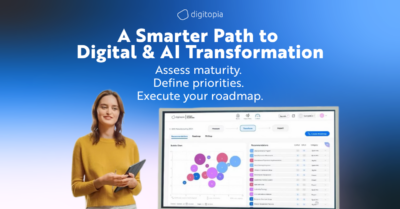
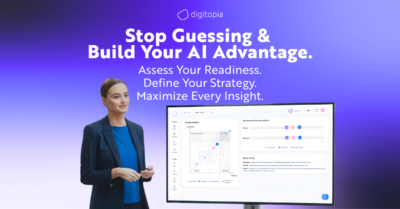
This is precisely why the first stage of a serious AI journey should begin with a structured assessment. Digitopia’s DAIMI provides CIOs and executive teams with a way to evaluate where the organization truly stands. It turns vague impressions into visible strengths and gaps. It helps leadership move beyond headline enthusiasm into operational reality.
That reality usually contains surprises.
Some companies discover that their governance is stronger than their execution capacity. Others find they have data assets but weak business engagement. Some have isolated technical talent but little AI literacy across the wider workforce. Others have ambitious business leaders but no clear decision rights, no prioritization logic, and no mechanism for scaling what works. In many cases, the issue is not that the organization is unprepared everywhere. The problem is that readiness is uneven.
That unevenness matters because AI transformation only scales when several capabilities advance together.
A company is not ready simply because it has bought a platform, hired a few specialists, or launched a few pilots. Real readiness rests on six broader questions.
First, does the company have a clear AI ambition aligned with business goals? If AI is still framed mainly as a technology topic rather than a strategic business agenda, readiness is weak.
Second, does the enterprise have leadership alignment? If the CEO, CIO, business leaders, HR, finance, risk, and operations are not aligned on direction, trade-offs, and priorities, readiness is fragile.
Third, is the organization capable of delivery? This includes data, platforms, integration, product management, change management, security, and cross-functional execution.
Fourth, does the workforce have the skills and confidence to work with AI? Not just technical experts, but managers, process owners, and knowledge workers.
Fifth, is governance enabling responsible progress, or merely slowing everything down? In early stages, many organizations overcorrect toward caution, suppressing learning and delaying value.
Sixth, does the organization know how it will measure progress and success over time? Without leading and lagging indicators, readiness cannot improve systematically.
These are not academic concerns. They define the enterprise’s ability to move from curiosity to capability.
This is why DAIMI should appear early in every AI transformation conversation. It gives CIOs a disciplined way to bring the truth to the surface. It does not just score maturity. It creates executive dialogue. It helps leaders compare perceptions. It makes the invisible visible. It allows the company to say, with clarity, “Here is where we are strong. Here is where we are exposed. Here is where we must act first.”
That becomes the foundation for the second stage of leadership: strategic prioritization.
Once readiness gaps are visible, the CIO must guide the organization from diagnosis to decision. Not every gap should be tackled at once. Not every capability deserves equal investment. Not every business area should move at the same speed.
This is where DAIMI becomes a roadmap engine. It helps leadership translate readiness findings into strategic priorities and a sequenced transformation plan.
For example, if governance is mature but experimentation is weak, the roadmap may need to create safer sandboxes, simplified approval paths, and low-risk pilot mechanisms. If the workforce lacks confidence, the roadmap may emphasize literacy, manager enablement, and targeted role-based learning. If use cases are scattered, the roadmap may focus on portfolio management and business-value prioritization. If delivery is the bottleneck, the roadmap may prioritize platform capabilities, product teams, or an AI enablement structure.
A readiness-based roadmap is powerful because it is realistic. It does not copy what another company is doing. It reflects the company’s actual situation.
That roadmap should again be designed across three horizons.
This year, CIOs should establish an enterprise baseline. Run the DAIMI assessment. Create an honest readiness narrative for the executive team. Identify the top few readiness gaps most likely to block value creation. Prioritize foundational actions: governance calibration, literacy, portfolio selection, delivery model definition, and executive alignment.
In the medium term, through 2027 and 2028, the company should convert readiness into repeatable capability. AI should move from limited pilots into scaled deployments. Role-based enablement should spread across functions. Core workflows should be redesigned with AI participation in mind. Governance should mature into adaptive control. Investment decisions should become more evidence-based.
By 2030, readiness should no longer be a special program. It should be built into the operating model. New products, processes, hiring plans, technology investments, and performance reviews should all assume that AI capability is a strategic requirement.
But readiness is not something a company achieves once and then forgets. It changes as the enterprise matures and as AI itself evolves. That is why the third stage is crucial: execution discipline.
In the second half of the AI journey, the challenge is no longer identifying what is missing. The challenge is making progress visible, sustained, and manageable.
This is where the third DAIMI embed matters. Readiness must be reviewed, tracked, and operationalized. CIOs need a way to monitor maturity improvements over time, revisit assumptions, and adjust priorities as the organization learns.
Execution requires a cadence. Quarterly reviews should examine not only project outputs, but also readiness indicators: adoption, literacy, capability development, governance quality, business engagement, and portfolio health. Annual reassessment should reset the baseline. Leaders should be able to answer not just “What have we launched?” but “Have we become more ready as an enterprise to create value with AI?”
That question is more strategic than it sounds.
Because in the coming years, the companies that move fastest will not necessarily be those with the largest budgets or the most sophisticated technical teams. They will be the ones with the greatest organizational readiness to absorb change, align priorities, and execute consistently.
CIOs should take pride in this. Readiness is not a soft topic. It is a hard business advantage.
A well-prepared organization makes better bets, scales faster, wastes less money, learns sooner, and builds more trust with the business. An unprepared organization does the opposite. It confuses motion with progress.
So before the next pilot, the next procurement, or the next AI announcement, pause and ask the real question:
How ready are we for AI transformation?
If the answer is unclear, start there.
Because readiness is not a footnote to AI success.
It is the beginning of it.