

CIO AI Transformation Blog Series – 6.Why AI Is the CIO’s Moment to Lead Enterprise Transformation
AI is turning the CIO role into one of the most strategic leadership positions in the enterprise. As technology, data, governance, operating models, workforce transformation, and execution converge, CIOs have the opportunity to move beyond IT stewardship and become enterprise architects of the future. With Digitopia’s DAIMI, CIOs can measure digital and AI maturity, create executive alignment, prioritize transformation initiatives, and track progress with discipline. The CIOs who lead with measurement, orchestration, business fluency, and execution credibility will shape not only AI transformation, but also the future of enterprise leadership.



For years, many CIOs have lived with an awkward contradiction.
They were critical to the business, yet not always seen as central to its future. They ran complex technology environments, managed risk, modernized systems, kept operations stable, supported growth, and enabled transformation. Yet in many organizations, they were still perceived primarily as infrastructure stewards, service providers, or custodians of IT efficiency.
That era is ending.
AI is changing the leadership equation.
This is the time to shine for CIOs because the business is entering a period where technology, data, operating model redesign, workforce transformation, governance, and strategic execution are converging at unprecedented speed. In that convergence, the CIO’s natural position becomes far more powerful.
The CIO now has the opportunity to move from trusted operator to enterprise architect of the future.
But this moment should not be romanticized. It is not automatic. Not every CIO will seize it. Some will remain too focused on tooling, platforms, and narrow enablement. Some will over-index on AI productivity. Some will let the business run ahead without a coherent architecture. Some will talk about AI but avoid the harder work of organizational redesign and execution discipline.
The CIOs who rise will be different.
They will understand that AI is not a side initiative. It is a leadership agenda that reaches across the business model, the operating model, talent, governance, customer experience, and enterprise value creation. They will know how to translate technological possibility into business direction.
And they will act accordingly.
The first mark of such leadership is measurement.
A CIO who wants to lead AI transformation credibly cannot rely on instinct, anecdotes, or vendor narratives. They must begin with a disciplined understanding of where the organization stands. You can’t manage what you can’t measure.
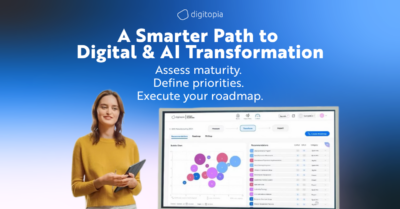
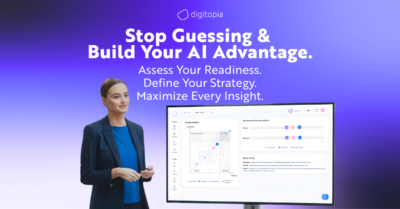
This is why Digitopia’s DAIMI belongs at the beginning of the CIO leadership story. It gives the CIO a way to frame the conversation with executives around reality rather than hype. It shows where the company is ready, where it is exposed, and where maturity gaps threaten progress. It creates executive alignment not through charisma alone, but through evidence.
That matters because leading AI is not about sounding visionary. It is about making the enterprise legible to itself.
When a CIO uses DAIMI effectively, they gain something far more valuable than a score. They gain a strategic language for the boardroom. They can discuss ambition, capability, sequencing, risk, and readiness with authority. They can anchor decisions in a shared fact base. They can show that the path to AI success is not random experimentation, but managed transformation.
This is the beginning of a different kind of CIO credibility.
The second mark of the rising CIO is strategic orchestration.
The AI era does not need CIOs who simply approve infrastructure or buy tools. It needs CIOs who can build a coherent enterprise roadmap. That means helping the company answer hard questions.
Where will AI matter most for growth, cost, quality, speed, customer value, and resilience? Which business capabilities must be redesigned first? Which investments are foundational, and which are opportunistic? Where should we centralize? Where should we federate? How do we sequence change so the organization can absorb it?
This is the second place where DAIMI becomes central. It helps the CIO move from assessment to prioritization and roadmap. The mature CIO does not chase every AI trend. They use maturity insights to define strategic focus.
That roadmap should again span three horizons.
This year, the CIO should use assessment to align leadership, prioritize the first waves of enterprise AI effort, and define the operating principles for governance, capability-building, and value realization. This year is about building confidence and direction.
By 2027 and 2028, the CIO should be visibly shaping how the company works. AI should be moving into core processes, customer journeys, service models, and management routines. The CIO should be seen as a business transformation leader, not just a technology sponsor.
By 2030, the best CIOs will have helped rewrite the enterprise’s DNA. They will have influenced how value is created, how work is structured, how decisions are made, and how the organization competes.
This is precisely why the CIO role is now a credible route to the CEO office.
In the past, some boards questioned whether CIOs were close enough to the business. In the AI era, that objection weakens dramatically. The future CEO must understand technology-enabled business models, enterprise operating-model redesign, transformation execution, workforce evolution, cyber risk, data governance, and strategic investment logic. Those are increasingly domains where strong CIOs have real depth.
But becoming a CEO candidate requires more than technical fluency. It requires demonstrating three broader capabilities.
First, business fluency. The CIO must speak the language of growth, value proposition, margin, customer experience, brand, talent, and market position.
Second, enterprise influence. The CIO must align peers, not just manage teams. They must create movement across silos.
Third, execution credibility. The CIO must show that they can turn ambition into measurable outcomes across the enterprise.
This is where the third DAIMI embed matters: execution.
The CIO who wants to shine cannot be a strategist without a management system. They must create cadence, visibility, and accountability. DAIMI provides the structure to reassess maturity, review progress, and keep the organization honest.
Quarterly reviews should not only examine initiative status, but also enterprise development: readiness, adoption, capability-building, governance effectiveness, and business engagement. Annual reassessments should refresh the roadmap and prove that the organization is maturing, not just experimenting.
This kind of discipline matters enormously for career trajectory.
Boards and CEOs do not elevate leaders because they talk convincingly about the future. They elevate leaders because they repeatedly demonstrate that they can guide the organization through complexity, uncertainty, and change.
That is what the best CIOs can now do.
They can show that they understand the technology. They can show that they understand the business implications. They can show that they can align peers. They can show that they can lead transformation at scale. They can show that they can create value while managing risk.
This is not merely a role expansion. It is a leadership re-rating.
So yes, this is the time to shine for CIOs.
Not because AI has made technology fashionable.
But because AI has made enterprise reinvention unavoidable, and the CIO is one of the few executives positioned to lead that reinvention end to end.
The CIO who embraces that responsibility will not remain in the background.
They will shape strategy.
They will shape execution.
They will shape the future organization.
And in many companies, they may very well shape the future of the CEO role itself.