

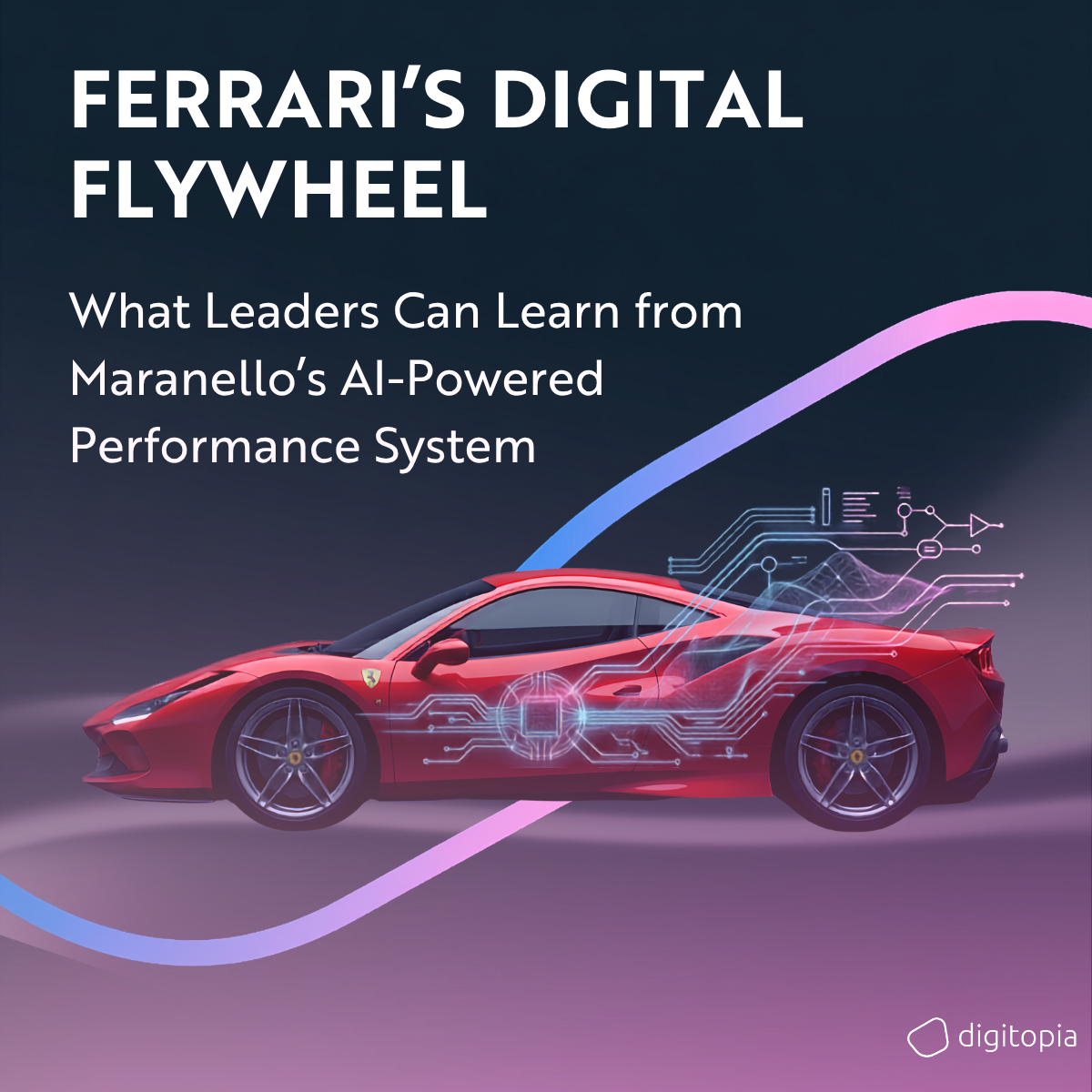
Ferrari’s Digital Flywheel: What Leaders Can Learn from Maranello’s AI-Powered Performance System
Ferrari’s success is not built on heritage alone. Behind its luxury positioning and Formula 1 performance sits a disciplined digital flywheel powered by data, software, AI and leadership clarity. This article explores how Ferrari connects racing, manufacturing, personalization and electrification into one performance system.



Ferrari digital transformation is not built on heritage alone. Behind the brand’s luxury positioning and Formula 1 performance sits a disciplined digital flywheel powered by data, software, AI and leadership clarity.
It delivers far fewer cars than mass-market automakers, yet commands revenues, margins, and market confidence that many larger players can only envy. Its road-car business remains one of the strongest examples of premium positioning in the automotive industry, while Scuderia Ferrari continues to compete in one of the most demanding performance environments in the world, Formula 1.
But Ferrari’s advantage is not built on heritage alone.
Behind the brand, the craftsmanship, and the racing legacy sits something more modern: a performance system powered by data, software, artificial intelligence, and disciplined execution.
Ferrari is not simply using digital tools to modernize isolated parts of the business. It is building a flywheel where knowledge moves between the factory, the road-car business, and the racing team. What is learned on the track can inform engineering, simulation, manufacturing, and customer experience. What is built for the road-car business can strengthen personalization, efficiency, and long-term strategic flexibility.
For executives, this is where the real lesson begins.
Ferrari shows that digital transformation is not about adding technology to the organization. It is about embedding intelligence into the way the organization performs.
Software Has Become a Performance Part
Ferrari’s leadership choices send a clear signal.
The appointment of Benedetto Vigna, formerly of STMicroelectronics, as CEO marked more than a change in executive profile. It reflected a broader recognition that chips, software, algorithms, and electronics are now central to automotive performance.
This matters because modern cars are no longer defined only by engines, materials, and design. They are increasingly shaped by software architecture, simulation capabilities, data flows, and the ability to test and improve systems faster.
Ferrari has leaned into model-based development and hardware-in-the-loop testing to accelerate electronics and software development. These practices reduce risk, shorten debugging cycles, and allow engineering teams to test complex systems before they reach the physical vehicle.
On the racing side, Team Principal Frédéric Vasseur has emphasized clarity, speed, and tighter decision loops. In Formula 1, fragmented decisions are costly. The same is true in transformation. When data, engineering, leadership, and execution are disconnected, performance suffers.
The executive lesson is simple but often overlooked: digital transformation requires leaders who understand software economics, not only operational excellence. The organizations that move fastest are not the ones with the most tools. They are the ones where leadership can translate technology into performance.
Ferrari Digital Transformation: Scarcity, Personalization, and Pricing Power
Ferrari has always understood scarcity. But its modern growth story adds another layer: digital personalization at scale.
Luxury economics depend on more than volume. They depend on mix, margin, customer experience, and the ability to make each purchase feel specific without making the operating model inefficient.
This is where digital becomes strategic.
Ferrari’s configurator, customer ecosystem, and personalization capabilities allow clients and dealers to shape highly specific vehicle experiences. But these systems do more than improve the buying journey. They also generate structured data about customer intent, preferences, and configuration patterns.
That data can then inform recommendations, production planning, commercial strategy, and future product decisions.
Generative AI adds another layer to this system. Ferrari has reportedly used AI to speed simulations, create internal knowledge bases, and support hyper-personalized configuration suggestions. In other words, AI is not treated as a generic productivity experiment. It is attached to areas where Ferrari already has economic leverage.
This distinction matters.
Many companies begin with the question, “Where can we use AI?” Ferrari’s example suggests a better question: “Where can intelligence improve our unit economics?”
For one company, that may mean higher personalization margins. For another, it may mean lower rework, faster service delivery, better asset utilization, or improved customer retention.
The point is not to copy Ferrari’s use cases. The point is to copy the logic: connect AI to the economic engine of the business.
From Pit Stops to Virtual Sensors: AI That Solves Real Bottlenecks
Ferrari’s work with AWS offers a practical example of how AI creates value when it is aimed at specific operational constraints.
One use case is pit stop analytics. In Formula 1, tiny execution losses matter. Manually synchronizing video feeds with telemetry is slow, repetitive, and prone to error. Ferrari built a machine learning pipeline to align video and data more efficiently, reportedly reducing synchronization time significantly and enabling faster root-cause analysis.
This is a strong AI use case because the problem is clear, the process is measurable, and the business impact is obvious. Faster analysis means faster learning. Faster learning can improve race execution.
Another example is the virtual ground-speed sensor. Physical sensors add cost, weight, complexity, and potential points of failure. By training AI models to provide reliable signals without relying on the same physical setup, Ferrari can reduce weight and improve engineering flexibility.
In manufacturing, Ferrari has also used centralized data and machine learning to analyze power-unit assembly processes, detect anomalies, and improve quality at source.
These examples are powerful because they are not abstract innovation showcases. They are targeted interventions.
They address time-to-insight, sensor dependency, assembly quality, cost, and reliability. They also create reusable patterns. A machine learning pipeline built for one performance context can inform how data, models, and workflows are reused elsewhere in the enterprise.
For executives, this is one of the most important lessons in the Ferrari playbook: start with bottlenecks, not buzzwords.
Find the process where speed, quality, cost, or decision accuracy matters. Instrument it. Improve it. Then scale the pattern.
AI Augments Expert Teams, It Does Not Replace Them
Ferrari’s digital advantage also depends on culture.
In high-performance environments, experts do not adopt AI because it is fashionable. They adopt it when it helps them make better decisions faster.
That requires trust.
Machine learning can flag anomalies, identify patterns, accelerate analysis, and reduce manual work. But engineers, designers, race strategists, and manufacturing teams still need to interpret the output and decide what to do next.
This is a critical point for any organization pursuing AI transformation. Adoption does not happen because a model exists. Adoption happens when the model fits naturally into the workflow of the people expected to use it.
Ferrari’s context makes this especially clear. Race engineers, data engineers, performance specialists, designers, and manufacturing teams need to work from a shared intelligence base. When data is fragmented, expertise slows down. When data is usable, expertise compounds.
The broader business lesson is this: AI should not be positioned as a replacement for the organization’s best people. It should be designed as a force multiplier for them.
That means investing not only in models, but also in workflow integration, data quality, training, governance, and change management.
Performance Gains Finance the Next Lap
Ferrari’s digital flywheel is also connected to financial discipline.
Its strong revenue, profitability, and market valuation are not separate from its operating model. They are reinforced by it. Personalization, premium mix, brand strength, manufacturing discipline, and technical capability all support each other.
This is why transformation needs visible wins.
When digital initiatives create measurable impact, they build confidence. Confidence protects investment. Investment builds capability. Capability creates the next round of performance improvement.
Too many companies treat transformation as a one-time program. Ferrari’s example is closer to continuous performance management. Each improvement creates evidence. Each evidence point strengthens the case for the next move.
The lesson is not just to celebrate success. It is to measure success in a way that funds momentum.
The Road Ahead: Electrification, AI, and Strategic Optionality
Ferrari’s transformation is far from finished.
The 2026 Formula 1 regulations will create new demands around aerodynamics, power units, simulation, and race strategy. These changes will test every team’s ability to learn quickly and adapt under pressure.
Off the track, Ferrari’s e-building in Maranello reflects the company’s move toward electrification while preserving flexibility across internal combustion, hybrid, and electric platforms. This is not only a product decision. It is a capability decision.
In volatile technology cycles, optionality matters.
Executives often want certainty before investing in new capabilities. But the more realistic approach is to build systems that can adapt as demand, regulation, technology, and customer expectations change.
Ferrari’s path suggests that the winning move is not to predict every detail of the future. It is to build the platforms, partnerships, talent, and operating rhythms that make adaptation faster.
What Other Companies Can Borrow from Ferrari
Most companies cannot, and should not, try to become Ferrari. But many can learn from the way Ferrari connects digital capability to business performance.
First, make leadership digitally bilingual. Digital transformation cannot remain the responsibility of the CIO alone. Business leaders need to understand software, systems, data, and AI well enough to sponsor initiatives with clear P&L relevance.
Second, aim AI at unit economics. Choose use cases that improve margin, reduce waste, increase speed, improve customer value, or strengthen reliability. AI roadmaps should not be built around technology categories. They should be built around value levers.
Third, create a two-way flywheel. Ferrari connects learning across racing and road cars. Other companies can do the same between frontline operations and headquarters, between digital channels and product teams, or between pilot sites and the broader enterprise.
Fourth, instrument execution, not only outcomes. Ferrari’s pit stop analytics matter because the process itself is measured. Companies should do the same with cycle time, handoffs, data freshness, quality issues, adoption, and decision latency.
Fifth, codify capability. A successful AI project is valuable. A reusable AI capability is far more valuable. Data platforms, governance models, MLOps practices, simulation environments, and internal knowledge systems should be treated as enterprise assets.
Where Digitopia Fits
Ferrari’s story reinforces something we see across Digitopia customers every day: what gets measured gets done.
Digital and AI transformation cannot depend on ambition alone. Leaders need a clear baseline, an objective view of maturity, and a practical roadmap that connects investment to value.
Digitopia helps organizations build that clarity through digital and AI maturity assessments, benchmarking, and roadmap discipline.
A maturity assessment shows where the organization stands across strategy, value, data, technology, capabilities, governance, and execution. Benchmarking places that position in context, helping leaders understand how they compare with peers and where the biggest gaps sit. A roadmap then turns those gaps into sequenced initiatives with ownership, funding logic, and measurable outcomes.
This is where transformation becomes manageable.
Instead of chasing scattered AI experiments, leaders can prioritize the few moves that matter most. Instead of debating opinions, teams can work from evidence. Instead of losing momentum after the first wave of enthusiasm, organizations can track progress and keep improving quarter after quarter.
Transformation Is a Team Sport
Ferrari’s advantage is cultural as much as technical.
Designers, engineers, software specialists, manufacturing teams, race strategists, and executives all contribute to the same performance system. The value does not come from one isolated technology. It comes from the way the organization learns.
That is the deeper lesson for business leaders.
Transformation is not a technology project. It is not a dashboard. It is not an AI announcement. It is a corporate performance discipline.
Ferrari shows what happens when data, software, leadership, and execution reinforce one another. The company protects its heritage while building new capabilities. It maintains scarcity while scaling personalization. It competes on emotion while operating with discipline.
For companies outside Maranello, the message is clear.
Build your own flywheel. Measure where you are. Identify where value can move faster. Invest in the capabilities that compound. Execute with focus. Celebrate the wins. Then repeat.
Because in transformation, as in racing, there is always another lap.
Sources
This article draws on publicly available information from Ferrari N.V., Formula 1, Amazon Web Services, and CompaniesMarketCap, including Ferrari’s FY 2024 financial results, AWS Ferrari case studies, Formula 1 leadership updates, Ferrari’s e-building announcement, and current automaker market capitalization rankings.