

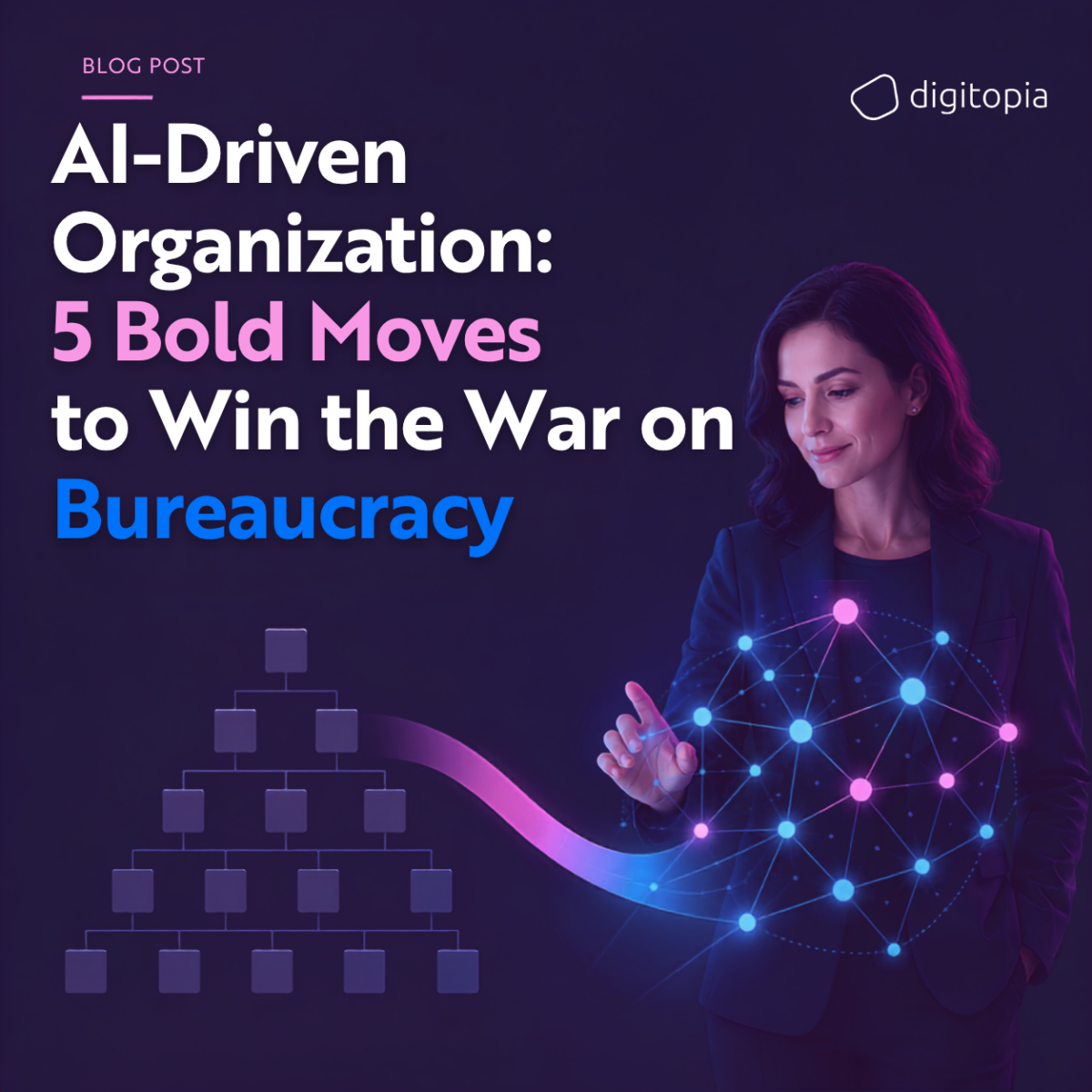
AI-Driven Organization: 5 Bold Moves to Win the War on Bureaucracy
Decision Intelligence helps organizations steer digital and AI transformation using maturity data rather than assumptions. By establishing a credible baseline, exposing capability gaps, improving prioritization, and measuring progress over time, maturity assessments become a continuous management system for making better transformation decisions.



On March 31, 2026, Jack Dorsey published a short essay with an immodest title: From Hierarchy to Intelligence. In it, he and Sequoia’s Roelof Botha describe corporate hierarchy as a two-thousand-year-old information routing protocol. The Roman army invented it. Prussian generals formalized it. Railroad engineers imported it into business. Now, they argue, it has finally reached the end of its useful life.
Five weeks earlier, Dorsey had laid off 40% of Block’s workforce. His stated ambition was radical. Collapse five layers of management into two or three. Replace the org chart with just three roles: Individual Contributors who do the work, Directly Responsible Individuals who own outcomes, and Player-Coaches who guide without administering. Coordination itself would shift from managers to an AI “world model” of the company.
It is easy to dismiss all of this as Silicon Valley theater. It is equally easy to swallow it whole. Both reactions miss what is actually happening.
The AI-driven organization is neither hype nor inevitability. It is the first genuine opportunity in two centuries to redesign how large companies work, and it arrives with sharp edges that most leaders have not yet priced in.
Bureaucracy was never a choice. Until now. Understanding why requires going back to a law that has quietly governed every large company since the railroads.
The Iron Law of Corporate Bureaucracy
Start with an uncomfortable fact. Between 1983 and 2022, the share of managers and supervisors in the US workforce grew from 9.2% to roughly 13%.
That growth happened straight through the matrix era, the re-engineering era, the empowerment era, the agile era, and the holacracy era. Every one of those movements promised to flatten the corporation. Every single one failed.
Gary Hamel and Michele Zanini put the cost of excess corporate bureaucracy at 3 trillion dollars a year in the US alone. That is not a rounding error. That is an entire shadow economy of reports nobody reads, approvals nobody remembers granting, and meetings that exist to prepare for other meetings.
Every leadership team has felt the symptoms. Strategy decks that take six weeks to travel from the boardroom to the front line. Budget approvals that outlive the opportunity they were meant to fund. Talented people spending their best hours feeding the machine instead of serving the customer.
Why is bureaucracy so indestructible? Because it grows by mathematics, not by malice.
A 10-person company has 45 possible communication links. A 1,000-person company has about half a million. Organizational hierarchy is how companies compress that explosion into something a human brain can handle. It turns a web into a tree and places managers as routers at every node.
Once you have routers, you get everything else. Reports to verify what the routers pass along. Approvals to control what they decide. Rules added after every failure and removed after none. Bureaucracy is the scar tissue of coordination.
Here is the point most flattening crusades miss. Hierarchy was never a preference. It was the least-bad solution to a hard constraint, the limited information-processing capacity of human beings. Herbert Simon called it bounded rationality. Every COO knows it as “you cannot have 40 direct reports.”
Why the Pyramid Always Won
Ronald Coase asked in 1937 why firms exist at all. His answer was transaction costs. Organizing work inside a company is cheaper than negotiating every task on the open market.
Coordination inside the firm carries its own cost, though, and that cost is paid in management. Every additional employee adds more potential connections than the one before. Information must flow up, decisions must flow down, and someone has to filter, prioritize, and translate at every level.
The classic span of control settled at five to eight direct reports per manager for a reason. Beyond that number, a human router starts dropping packets.
So companies did the only rational thing available. They added layers. Each layer bought coordination capacity and paid for it in speed, distortion, and cost. A message passing through five levels arrives late and warped, like a corporate game of telephone. Decisions queue behind calendars. Local knowledge dies inside summary slides.
The great builders of modern management understood the tradeoff perfectly. Alfred Sloan’s multidivisional structure at General Motors in the 1920s was a masterpiece of its era precisely because it rationed scarce executive attention. It did not eliminate the routing problem. It organized around it.
None of this happened because executives loved paperwork. It happened because, for two hundred years, human managers were the only routing technology on the market. The pyramid was not a choice. It was a constraint wearing the costume of a strategy.
The distinction matters enormously. If hierarchy were merely a bad habit, culture change would fix it. Because it is a rational response to a real constraint, only moving the constraint can change the outcome.
Why Every Flat Organization Rebellion Failed
That constraint explains the graveyard of flat organization experiments.
Zappos adopted holacracy in 2014, the boldest self-management experiment of its era. Nearly a third of employees took a buyout rather than live inside it, and managers quietly returned through the back door.
Valve’s famously bossless handbook promised a company with no managers at all. Insiders later described the reality as “pseudo-flat,” with hidden hierarchies more opaque and more political than the official ones they replaced.
Hundreds of enterprises copied Spotify’s squads, tribes, and chapters. Most renamed their teams while keeping every approval chain intact. Spotify itself moved on from the model years ago.
Each experiment treated structure as the disease. Structure was only the symptom. The real disease was the coordination load itself, and the load did not care what the teams were called.
The pattern repeats with mechanical reliability. You can delete the org chart, but you cannot delete the coordination problem. As long as humans were the only routers available, the pyramid always grew back, sometimes wearing new vocabulary, always obeying the same physics.
This is exactly why the current moment deserves closer attention than a normal management fashion cycle, and why the AI-driven organization is a different kind of claim.
What Changed: The AI-Driven Organization Arrives
For the first time, a technology attacks the constraint itself rather than the symptoms.
AI systems can aggregate context across thousands of people. They can maintain a continuously updated picture of who is doing what, and why. They can route information, summarize status, flag conflicts, and schedule work across an entire enterprise.
Look at that list carefully. It is not a random sample of managerial tasks. It is the precise work that made middle management structurally necessary.
An AI-driven organization, then, is not a company that bought chatbot licenses. It is a company where machine intelligence carries the coordination load that human hierarchy used to carry, while people concentrate on judgment, creativity, and accountability.
Picture the day-to-day version. One agent reads every project channel and produces a single living status view. Another reconciles conflicting priorities between teams before they escalate. A third plans the quarter around real capacity instead of optimistic guesses. None of that requires a vice president. All of it used to.
The early evidence goes well beyond anecdote.
Harvard Business School’s research on AI-native firms finds that startups built around AI are about 25% smaller than comparable companies, with roughly 15% fewer managers, and they command higher valuations per head. Cursor, Midjourney, and Lovable generate between 2 million and 10 million dollars in revenue per employee. The traditional benchmark sits between 200,000 and 400,000 dollars.
The incumbents are converging on the same destination from the opposite direction. Bayer cut its management layers from twelve to six. Amazon mandated 15% more individual contributors per manager. Google removed a third of its small-team managers. Nvidia’s Jensen Huang runs the world’s most valuable company with sixty direct reports and no one-on-ones.
Sixty direct reports would have been managerial malpractice in 1990. Inside an AI-driven organization, it starts to look like an operating model.
Notice what is really being debated here. The conversation about AI in management is usually framed as robots replacing bosses. The reality is narrower and far more interesting. AI replaces the routing function of management, and the routing function is exactly what forced companies to build pyramids in the first place.
What Did Not Change: The Honest Limits of AI
Before anyone emulates Dorsey, read the fine print. The brutal truths matter more than the headlines.
Current and former Block employees report that some 95% of AI-generated code still requires human modification. The machine produces volume. Humans still produce correctness.
An NBER study found that many so-called AI layoffs were really corrections of pandemic-era overhiring wearing a fashionable costume. Harvard Business Review research suggests only about one in five corporate AI investments delivers measurable returns. Meanwhile “workslop,” plausible-looking but low-quality AI output, quietly taxes productivity in every team that confuses generation with progress.
The honest synthesis reads like this. AI compresses coordination. It absorbs the routing, reporting, aggregating, and scheduling work that filled managerial calendars. It does not yet supply judgment. It does not carry tacit knowledge. It does not develop people. And it cannot absorb accountability.
When an autonomous team fails, an AI cannot be the one who owns the failure. Someone with a name has to stand up.
That sentence belongs above every transformation roadmap. Accountability is not a workflow to automate. It is a human commitment that gives the rest of the system its meaning, and no model can make that commitment on your behalf.
Companies that simply delete their management layers will discover, expensively, which of those layers were load-bearing. An AI-driven organization is not a company minus its managers. It is a company redesigned around a new division of labor between human judgment and machine coordination.
5 Bold Moves to Build an AI-Driven Organization
The companies getting this right are rarely the loudest ones. They treat the transition as an engineering problem with a sequence, not a slogan with a launch date. The sequence looks like five deliberate moves.
1. Subtract Before You Substitute
Shopify deleted 12,000 recurring meetings before it told teams to prove AI could not do a job before requesting headcount. The order of operations is the whole point.
Automating your bureaucracy just digitizes the sludge. A useless report generated instantly is still a useless report. An approval that adds no judgment does not improve because a model routes it faster.
Run the audit first. List every recurring meeting, report, and approval inside a business unit. For each one, ask who consumes it and which decision it changes. Where the answer is silence, delete the artifact before you automate anything around it.
Subtraction is free, immediate, and politically revealing. It shows you exactly where bureaucracy exists to soothe anxiety rather than to coordinate work.
2. Attack Layers, Not Managers
The target is a structural role, not a population of people. What must go is the pure information router, the manager whose week consists of relaying status upward and instructions downward.
What must stay is everything AI cannot do. Judgment under ambiguity. Coaching that turns junior people into senior people. Accountability that survives a bad quarter.
Those capabilities should be concentrated in fewer, better-designed roles. Block’s “player-coach” is a useful name for the pattern: leaders who still practice the craft, guide others, and carry responsibility, without administering a reporting apparatus.
Treat the change as role redesign rather than headcount theater. A layoff that removes judgment along with routing destroys more value than it saves, and the bill arrives two quarters later, when nobody remembers why the system was built that way.
3. Give Autonomy a Spine
Every flat organizational structure that actually works pairs freedom with a hard accountability mechanism.
Haier’s microenterprises carry real profit-and-loss statements. Bayer’s teams commit to explicit outcomes in 90-day cycles. Amazon insists on single-threaded owners, meaning one accountable person per initiative with no committee to hide behind.
Flatness without a spine collapses into hidden hierarchy. Ask Valve. When formal structure disappears and nothing replaces its accountability function, informal power fills the vacuum. Informal power is invisible, unaccountable, and political, which makes it worse than the bureaucracy it replaced.
Autonomy is not the absence of structure. It is a different structure, one that attaches consequences to outcomes instead of activities.
4. Federate by Default
Keep central only what must be common: capital allocation, brand, compliance, and increasingly the AI platform itself. Push everything that touches a customer outward to the edge, where information is freshest and feedback is fastest.
Decades of evidence back the move. Stanford economist Nicholas Bloom’s research shows decentralized firms outperform in turbulent environments. Haier’s results after acquiring GE Appliances proved the model transplants across cultures and continents. Nobody is forecasting calm environments ahead.
Federation rewrites the center’s job description. Headquarters stops being a control tower and becomes a platform. It provides shared intelligence, shared infrastructure, and shared guardrails, while federated teams make the operating decisions.
In an AI-driven organization, the platform is the new hierarchy. It coordinates without commanding.
5. Make Work Machine-Readable
An AI coordination layer can only coordinate what it can see.
Decisions made in hallway conversations are invisible to it. Plans that live inside someone’s head do not exist for it. Metrics scattered across private spreadsheets might as well be encrypted.
The writing-first, artifact-first culture is no longer a remote-work preference. It is a precondition. Decisions need documents. Plans need artifacts. Metrics need instrumented systems rather than tribal memory.
This is the least glamorous move and the most foundational one. It determines whether your AI world model reflects your company or quietly hallucinates it. Skip this step and every other investment in the AI-driven organization sits on sand.
Where to Start: A 90-Day Reality Check
Grand redesigns collapse under their own weight. Sequenced ones compound. Transformation programs fail far more often from sequencing errors than from ambition deficits. A realistic first quarter looks like this.
Pick one business unit, not the whole company. Run the subtraction audit there and delete what fails it. Publish the before-and-after numbers internally, because visible wins buy political capital for the harder moves.
Instrument the work that remains. Move decisions into documents and metrics into systems, so the coordination layer has something real to coordinate.
Pilot AI on one coordination workflow, such as status aggregation across teams. Measure decision latency and coordination cost before and after. If the numbers do not move, stop and diagnose rather than scale.
Only then touch structure. Redesign roles in that unit around judgment, coaching, and accountability, and let the results argue for the next unit.
An AI-driven organization is built in disciplined quarters, not in press releases.
The Question for Every Leader
Does bureaucracy inevitably scale as the company scales?
For two hundred years the answer was effectively yes, because the constraint that produced it never moved. Now the constraint is moving. That does not make organizational hierarchy obsolete. It makes organizational design a genuine choice for the first time.
The iron law has been replaced by something more demanding, a test of judgment.
It is a test most companies will face under pressure, because competitors built without the old constraint are already setting new cost curves. Waiting for certainty is itself a decision, and an expensive one.
Some structure in your company is scar tissue. Some of it is load-bearing skeleton. AI finally makes it possible to tell the difference, and to remove the former without collapsing the latter. The leaders who pass the test will combine the courage to remove structure with the wisdom to know which structure was holding the roof up.
5 Questions Before You Touch the Org Chart
Ask five honest questions before any restructuring announcement. Which meetings, reports, and approvals would nobody miss if they vanished tomorrow? Where does real judgment live in your structure, and where does pure routing pretend to be judgment? What accountability mechanism will replace each layer you remove? How much of your work is machine-readable today? And who stands up, by name, when an autonomous team fails?
Honest answers to those five questions are worth more than any reorganization slide.
Digitopia helps leadership teams measure digital maturity, redesign operating models, and sequence transformation so that ambition survives contact with reality. Becoming an AI-driven organization is exactly that kind of journey: measurable, sequenced, and honest about its limits.
The pyramid served its purpose for two centuries. The tools to replace it finally exist. What happens next is, for the first time in the history of management, genuinely up to you.