

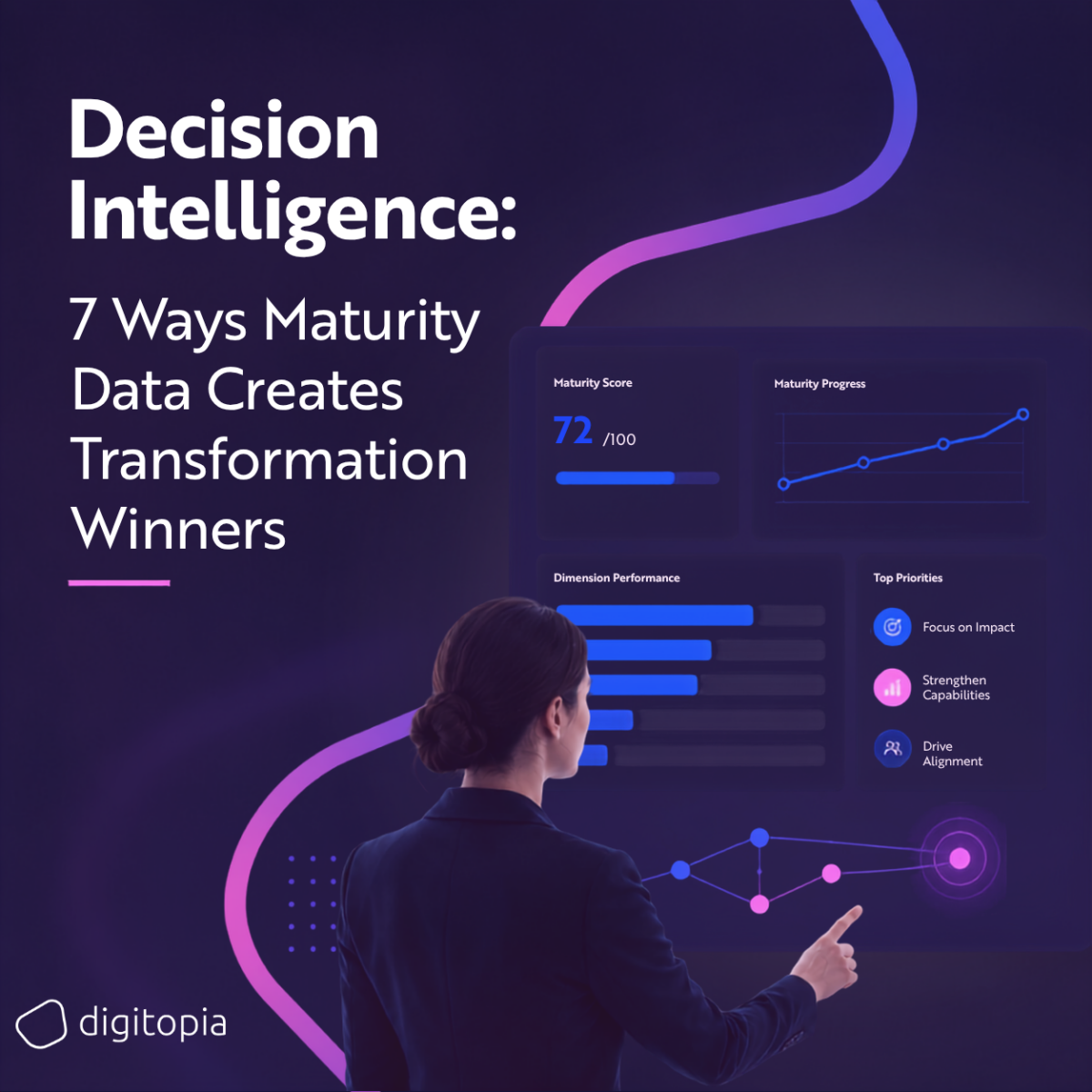
Decision Intelligence: 7 Ways Maturity Data Creates Transformation Winners
Decision Intelligence helps organizations steer digital and AI transformation using maturity data rather than assumptions. By establishing a credible baseline, exposing capability gaps, improving prioritization, and measuring progress over time, maturity assessments become a continuous management system for making better transformation decisions.



What evidence is guiding your transformation decisions?
Without reliable decision data, transformation becomes a collection of assumptions, competing priorities, and disconnected investments. Leaders may know that change is necessary, but they cannot clearly determine where to invest, what to fix, what to scale, or what to stop.
This is where Decision Intelligence becomes essential.
Decision Intelligence is the discipline of combining data, organizational context, human judgment, and structured analysis to improve decisions. In transformation, it provides the evidence leaders need to move from ambition to coordinated execution.
One of the most valuable sources of that evidence is maturity data.
A maturity assessment does far more than assign an organization a score. It establishes a credible baseline, exposes capability gaps, identifies dependencies, aligns leadership, supports prioritization, and measures whether transformation is producing genuine progress.
When used continuously, maturity data becomes an organizational steering system.
It shows where the organization stands, how prepared it is, which capabilities are holding it back, and whether current investments are moving the business forward.
That is how Decision Intelligence creates transformation winners.
Transformation Needs Steering, Not More Activity
One of the most common transformation mistakes is confusing activity with progress.
An organization may be running dozens of initiatives, testing new AI tools, modernizing platforms, hiring specialists, and holding strategy workshops. From the outside, it appears highly active.
But activity alone does not prove that the organization is becoming more capable.
Transformation requires leaders to make difficult choices:
- Which capabilities must be strengthened first?
- Which barriers are preventing initiatives from scaling?
- Which investments are producing meaningful value?
- Which programs are consuming resources without improving maturity?
- Where should leadership intervene?
- Which initiatives should be accelerated, redesigned, or stopped?
Without a shared evidence base, these decisions are often shaped by internal politics, executive enthusiasm, departmental pressure, or the latest technology trend.
The result is transformation drift.
Resources are distributed across too many initiatives. Dependencies are overlooked. Local successes fail to scale. Leadership loses visibility into whether the organization is actually progressing.
Decision Intelligence offers an alternative.
It creates a disciplined process for understanding the current state, identifying the most important capability gaps, and directing investment toward the areas most likely to improve performance.
Transformation stops being a sequence of hopeful initiatives and becomes a managed system of evidence-based choices.
1. Maturity Data Establishes a Credible Baseline
Every transformation needs a clear starting point.
Yet leadership teams often have very different views of the organization’s current capabilities. One executive may believe the company is advanced because several successful pilots are visible. Another may see fragmented data, weak governance, and limited adoption across business units.
Both perspectives may contain some truth.
The problem is that transformation cannot be steered effectively when leaders are working from conflicting assumptions.
A maturity assessment creates a common baseline.
It helps the organization answer:
Where are we really?
The baseline provides leadership with a structured view of current capabilities across areas such as:
- Strategy and leadership alignment
- Governance and accountability
- Technology architecture
- Data quality and accessibility
- Business and IT collaboration
- Process design
- Workforce capability
- Organizational culture
- Measurement discipline
- Risk and control
This shared understanding reduces ambiguity.
Instead of debating isolated examples, leaders can discuss transformation using a consistent set of evidence. The baseline becomes a reference point for setting priorities, defining realistic ambitions, and measuring future progress.
A credible baseline does not merely describe the organization.
It improves the quality of every decision that follows.
2. The Details Behind the Score Reveal the Real Barriers
A maturity score is useful, but it is only the beginning.
The most important information sits beneath the headline number.
Two organizations can receive similar overall scores while facing completely different transformation challenges. One may have strong technology capabilities but weak governance. Another may have clear leadership commitment but fragmented data and limited operational adoption.
The response required in each case is different.
Detailed maturity data reveals where the real bottlenecks exist.
It can show whether transformation is being constrained by:
- Unclear strategic priorities
- Weak executive alignment
- Poor data quality
- Fragmented ownership
- Inconsistent governance
- Limited workforce readiness
- Ineffective workflow redesign
- Weak measurement practices
- Misalignment between business and technology teams
- Inadequate risk controls
This matters because organizations frequently invest in the most visible problem rather than the most important one.
A company may assume it needs another technology platform when its real barrier is fragmented decision ownership. It may invest in additional AI use cases when poor data foundations prevent existing pilots from scaling. It may launch training programs when employees still lack the processes and incentives required to apply new capabilities.
Decision Intelligence exposes these mismatches.
It helps leaders diagnose the underlying capability system rather than reacting to symptoms.
3. Maturity Data Improves Transformation Prioritization
Transformation creates more possible initiatives than any organization can fund or execute simultaneously.
The central leadership challenge is therefore not generating ideas.
It is choosing what should happen first.
Maturity data supports prioritization by showing which capabilities are foundational, which gaps create the greatest risk, and which improvements can unlock progress across multiple initiatives.
For example, an organization may have several promising AI use cases. However, maturity data may reveal that data governance, workflow integration, and business ownership are not strong enough to support enterprise-wide deployment.
In that situation, launching additional pilots may create more activity without creating scalable value.
The better decision may be to strengthen shared data standards, redesign decision rights, and establish clear value measurement before increasing the number of use cases.
This is the difference between project prioritization and transformation prioritization.
Project prioritization asks:
Which initiative looks most attractive?
Transformation prioritization asks:
Which capability must improve so that multiple initiatives can succeed?
Decision Intelligence shifts leadership attention toward the second question.
It helps organizations invest in capability building, not just project delivery.
4. Repeated Assessments Turn Snapshots Into Intelligence
A one-time maturity assessment provides a snapshot.
Repeated assessments create intelligence.
Longitudinal maturity data shows whether the organization is genuinely becoming more capable over time. It enables leaders to compare transformation ambitions with actual movement and determine whether interventions are producing the intended results.
Repeated measurement helps answer questions such as:
- Are leadership alignment and governance improving?
- Is data maturity advancing fast enough to support AI adoption?
- Are new ways of working becoming embedded?
- Are capability gaps closing across the enterprise or only within selected teams?
- Are investments translating into measurable progress?
- Which interventions are producing the strongest maturity gains?
- Which weaknesses remain unchanged despite continued spending?
Patterns become visible as the dataset grows.
Leadership can see which capabilities improve quickly, which require sustained intervention, and which repeatedly block transformation outcomes.
This creates an organizational learning system.
Instead of judging progress through isolated success stories, leaders can assess whether the overall capability system is moving in the right direction.
Transformation is rarely linear. Some capabilities develop quickly, while others remain resistant because they involve culture, incentives, governance, or cross-functional collaboration.
Longitudinal maturity data makes these dynamics visible.
It allows leadership to adjust the roadmap before weak capabilities become expensive barriers.
5. Decision Intelligence Connects Capability Progress to Business Value
Maturity matters because capabilities influence outcomes.
The purpose of measuring maturity is not to achieve a higher score for its own sake. It is to improve the organization’s ability to create value, manage risk, respond to change, and execute strategy.
Decision Intelligence connects capability development to business performance.
For example:
- Better data maturity can improve decision speed and analytical reliability.
- Stronger governance can reduce duplication, risk, and uncontrolled experimentation.
- Improved workflow maturity can increase adoption and operational efficiency.
- Greater workforce capability can accelerate responsible use of AI and digital tools.
- Stronger measurement discipline can improve investment allocation.
- Better leadership alignment can reduce delays and conflicting priorities.
The maturity score does not directly create these outcomes.
The decisions made using maturity data do.
When leaders understand which capabilities drive specific business outcomes, they can allocate resources more effectively and build a stronger transformation business case.
This also changes how progress is communicated.
Instead of reporting only the number of projects completed, leaders can demonstrate how capability improvements are influencing:
- Revenue growth
- Cost efficiency
- Customer experience
- Productivity
- Innovation speed
- Operational resilience
- Risk exposure
- Time to decision
- Time to value
This creates a more credible link between transformation activity and enterprise performance.
6. Maturity Data Separates Scalable Progress From Isolated Success
A successful pilot is not the same as organizational maturity.
One team may deliver an impressive result using exceptional talent, executive sponsorship, or temporary workarounds. That result can be valuable, but it does not prove that the wider organization can reproduce or scale it.
Decision Intelligence helps leaders distinguish between isolated success and repeatable capability.
It asks whether the conditions behind the success are embedded across the organization.
Can other teams access the same quality of data?
Are governance processes clear?
Are employees prepared to use the new system?
Can the workflow operate without constant intervention?
Are outcomes measured consistently?
Can the organization manage the associated risks?
Is ownership clear after the pilot ends?
These questions determine whether a successful experiment can become an enterprise capability.
Without this maturity lens, organizations accumulate pilots that never become part of normal operations.
Maturity data reveals whether the business is building scalable habits or simply collecting disconnected success stories.
This distinction is particularly important in AI transformation.
AI maturity is not defined only by model quality or technical sophistication. It depends on the interaction between people, workflows, data, governance, and human judgment.
If one part of this system remains weak, the organization may struggle to scale value responsibly.
7. Decision Intelligence Creates a Continuous Transformation System
The strongest transformation programs do not treat assessment, strategy, execution, and measurement as separate activities.
They connect them into a continuous management system:
Baseline → Alignment → Roadmap → Mobilization → Measurement → Governance → Compounding Value
Baseline
The organization establishes a reliable view of its current maturity.
Alignment
Leadership develops a shared understanding of strengths, weaknesses, risks, and priorities.
Roadmap
Capability gaps are translated into sequenced actions, clear ownership, and measurable outcomes.
Mobilization
Teams, resources, and investments are coordinated around the selected priorities.
Measurement
Progress is tracked using maturity indicators, operational metrics, and business outcomes.
Governance
Leadership reviews evidence, manages risk, resolves dependencies, and adjusts investment decisions.
Compounding value
Capabilities strengthen over time, enabling faster execution, stronger adoption, and more scalable results.
This cycle turns maturity from a diagnostic exercise into an operating logic.
The organization does not assess maturity once and move on.
It continually uses evidence to improve the next decision.
Better Decisions Also Reduce Transformation Risk
Decision Intelligence is not only about accelerating growth.
It also helps organizations avoid preventable losses.
Poor transformation decisions can create significant downside:
- Duplicated investments
- Uncontrolled technology adoption
- Fragmented data environments
- Compliance exposure
- Cybersecurity vulnerabilities
- Low employee adoption
- Inconsistent customer experiences
- Expensive pilots that cannot scale
- Strategic initiatives with no clear ownership
- Transformation fatigue
Maturity data helps leadership identify these risks before they become embedded.
It shows whether governance is keeping pace with experimentation, whether data foundations are strong enough for advanced use cases, and whether employees are prepared for new responsibilities.
This becomes increasingly important as AI moves deeper into business processes and decision-making.
Organizations need to understand not only whether they can deploy AI, but whether they can govern, monitor, explain, and improve its use responsibly.
Maturity data creates visibility into those capabilities.
It supports transformation that is faster, but also more controlled, resilient, and trustworthy.
From Anecdotes to Evidence
Transformation reporting is often dominated by anecdotes.
A team presents a successful pilot. A leader shares an adoption story. A function reports that a new tool is improving productivity.
These stories can be valuable, but they are not enough to steer an enterprise.
Anecdotes highlight what happened in one situation.
Decision Intelligence reveals whether the organization is building the capabilities required to repeat that success.
A maturity-based system introduces:
- Consistent benchmarks
- Leading indicators
- Defined capability measures
- Clear accountability
- Regular governance reviews
- Outcome-linked progress tracking
- Evidence-based investment decisions
Leadership can then evaluate transformation using a broader and more reliable view.
Is progress widespread or isolated?
Are capability gains structural or temporary?
Is governance improving alongside innovation?
Are teams learning from previous interventions?
Is the transformation roadmap producing measurable movement?
These questions cannot be answered through stories alone.
They require structured evidence.
Decision Intelligence Is a New Leadership Discipline
Transformation leadership is increasingly becoming a data discipline.
The most effective leaders will not necessarily be those with the largest budgets, the greatest number of AI pilots, or the most ambitious technology programs.
They will be the leaders who can use evidence to make better choices.
They will understand the organization’s baseline.
They will examine the detail behind the score.
They will recognize dependencies between capabilities.
They will track progress over time.
They will connect maturity movement to business outcomes.
They will learn from interventions that work and stop funding those that do not.
Most importantly, they will use Decision Intelligence to focus the organization on the capabilities that matter most.
This creates a significant competitive advantage.
While other organizations react to trends, mature organizations build the ability to decide, execute, learn, and adapt continuously.
They do not simply move faster.
They move with greater clarity.
Transformation Winners Steer With Evidence
Transformation does not need more activity.
It needs better steering.
Better steering begins with better decision data.
A maturity assessment is therefore not merely a scorecard. It is one of the most valuable transformation datasets an organization can build.
It provides a baseline, a capability map, a prioritization mechanism, a progress tracker, a learning system, and a decision engine.
Used continuously, it helps leadership understand:
- Where the organization stands
- Which capabilities are limiting progress
- What must change first
- Whether investments are working
- Where risk is accumulating
- How transformation should be adjusted
That is the purpose of Decision Intelligence.
Not more data for its own sake.
Better decisions because the right evidence is finally visible.
The organizations that become transformation winners will not manage change through instinct, enthusiasm, or isolated success stories.
They will steer it with evidence.