

CIO AI Transformation Blog Series – 5.AI Success Starts With Transformation Maturity
AI success depends on an organization’s transformation maturity, not simply access to tools, models, vendors, or pilots. Enterprises need the leadership alignment, governance, prioritization, change management, execution discipline, and operating rhythm required to scale AI into measurable business value. Digitopia’s DAIMI helps CIOs and executive teams assess where ambition is outpacing capability, identify maturity gaps, build a sequenced roadmap, and monitor progress over time. With a strong Transformation Management Office and a capable Chief Transformation Officer, AI becomes part of a disciplined enterprise transformation agenda that can carry the organization toward continuous reinvention by 2030.



Most AI programs do not fail because the technology is weak.
They fail because the organization is not mature enough to transform.
That may be the most important lesson CIOs and executive teams need to absorb right now. AI success is not mainly a question of access to models, tools, vendors, or pilots. Those are now widely available. The real differentiator is whether the company can align leadership, prioritize intelligently, mobilize the organization, manage change, orchestrate execution, and sustain momentum over time.
In other words, AI success depends on transformation maturity.
This is why enterprises that are serious about AI need more than an AI strategy. They need a transformation management system.
And that is exactly where one of the most overlooked leadership ideas becomes decisive: the company should establish a Transformation Management Office and empower a Chief Transformation Officer to orchestrate enterprise change at scale.
Many businesses still think of transformation as an occasional program, a PMO function, or a set of disconnected initiatives. That mindset no longer fits reality. In the age of AI, transformation becomes continuous. Priorities shift faster. Business models evolve faster. Work design changes faster. Technology possibilities expand faster. Organizational fatigue rises faster. Without strong transformation maturity, AI ambition will outpace enterprise capacity.
This is why the future belongs not only to companies that invest in AI, but to those that know how to transform around it.
For CIOs, this is critical. Because AI programs tend to expose every weakness in execution: unclear ownership, weak governance, poor prioritization, lack of change management, low adoption, fragmented roadmaps, and inadequate follow-through. The CIO therefore has a strategic interest in helping the enterprise mature its transformation muscle.
That journey starts with measurement.
What’s measured gets done. If a company cannot assess its transformation maturity in the context of AI, it cannot manage it. It cannot know whether it has the leadership alignment, governance capacity, workforce readiness, execution discipline, or operating-model clarity needed to scale value.
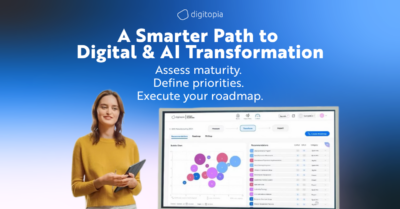
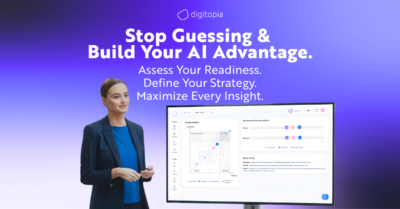
Digitopia’s DAIMI is particularly powerful here because it allows the enterprise to assess the maturity conditions that shape AI success. It helps leadership understand where ambition is outpacing capability. It surfaces the gaps between intention and execution. It turns abstract discussions about “readiness” and “change” into a visible fact base.
This is the first place DAIMI should be embedded in the narrative. The early stage of the article should make one thing clear: organizations do not fail at AI only because they choose the wrong use cases. They fail because they lack transformation maturity.
That maturity includes several elements.
Can leaders align behind a shared agenda? Can the company prioritize rather than chase every idea? Can business and technology teams work together effectively? Can governance enable action without losing control? Can the workforce adapt? Can the enterprise sustain an execution cadence over years rather than weeks?
If the answer to these questions is weak, AI success will remain shallow.
Once the assessment establishes the baseline, the second stage is strategic translation.
This is where DAIMI becomes a roadmap enabler.
A mature transformation agenda does not try to fix everything at once. It translates assessment findings into a sequenced plan with ownership, governance, milestones, and decision rights.
This is where the Transformation Management Office becomes indispensable.
A TMO is not another layer of administration. At its best, it is the enterprise mechanism that turns strategy into coordinated execution. It helps leadership connect initiatives, manage interdependencies, resolve trade-offs, monitor progress, and keep the transformation aligned with business outcomes.
In the AI era, the TMO should sit at the center of three challenges.
First, portfolio discipline. There will always be more AI ideas than the organization can absorb. Someone must ensure that the portfolio reflects strategic priorities rather than organizational noise.
Second, execution orchestration. AI initiatives often depend on shared data, platforms, policies, talent, and process redesign. Without orchestration, duplication and delay multiply.
Third, change synchronization. AI affects roles, workflows, governance, and culture simultaneously. The organization needs a central mechanism that can see across those changes.
This is why the Chief Transformation Officer is becoming such a strategically important role. The best Chief Transformation Officer is not merely a program monitor. He or she is the executive who can translate enterprise ambition into execution reality. That is a rare and valuable capability.
In fact, if a Chief Transformation Officer performs exceptionally well in the AI era, this may become one of the strongest pathways to the CEO role.
Why? Because the future CEO will not be judged only on strategy formulation. They will be judged on the ability to mobilize the whole enterprise through continuous reinvention. A leader who can align functions, accelerate execution, manage complexity, and create measurable business outcomes through transformation will be uniquely well prepared for the top job.
That is not a rhetorical statement. It is a structural shift in what enterprises will need from leadership.
The roadmap should reflect three horizons.
This year, the enterprise should assess maturity through DAIMI, clarify the role of the TMO, define executive sponsorship, establish portfolio governance, and create a practical transformation roadmap for AI. This year is also the time to define common progress metrics, review cadences, and accountability structures.
By 2027 and 2028, the TMO should evolve from coordination toward enterprise steering. It should help manage multiple cross-functional AI workstreams, ensure resources follow priority, support business-unit execution, and keep leadership focused on value realization rather than scattered activity.
By 2030, transformation maturity should be a core enterprise capability. AI should be embedded in the company’s strategy, operating model, funding logic, and performance system. The TMO should no longer be seen as a temporary body, but as a central orchestration capability for continuous reinvention.
But strategy and structures still do not guarantee results. The third and most practical question is execution.
This is the third place DAIMI should be embedded: as a mechanism for monitoring and improving transformation maturity over time.
Execution requires feedback loops.
It requires regular reassessment, portfolio review, barrier removal, capability-building, and leadership attention. DAIMI gives the organization a way to revisit where it stands and how far it has moved. It makes maturity visible, not theoretical.
Quarterly reviews should go beyond use-case ROI to examine transformation health. Are decision rights clear? Is governance helping or hindering? Are teams aligned? Is adoption improving? Are bottlenecks being removed? Is the company learning faster?
Annual reassessment should guide strategy refresh and reprioritization.
Because in the end, AI success is inseparable from transformation maturity.
The organizations that scale AI well are not simply the most innovative. They are the most disciplined. They know how to turn ambition into sequencing, sequencing into execution, and execution into business value.
For CIOs, this is a crucial message to champion.
AI is not just a technology opportunity. It is an enterprise transformation test.
And for companies willing to take transformation seriously, there is upside beyond AI itself.
They build a stronger enterprise. A more adaptive culture. A better operating rhythm. A more aligned leadership team. A sharper portfolio discipline.
That is why the message is so important:
If you want AI success, invest in transformation maturity.
And if you want transformation maturity, build the structures, roles, and management discipline that can carry the enterprise into 2030.