

AI Transformation: 3 Steps to Master Change and Win by 2030
AI transformation is not a tooling race. It is a maturity race. Assess where you are, define where you must be, and execute with governance and discipline. That is how companies win by 2030.



How much do you want to, can you, or must you transform?
CEOs are overwhelmed. Not only because AI is accelerating change, but because AI transformation is expanding the number of things that now need to change at the same time: strategy, governance, operating model, talent model, customer model, technology foundation, risk model, and speed of execution. Recent leadership transitions at Coca-Cola and Walmart have even been discussed in terms of the next wave of AI transformation and the need for leadership fit for that era.
That is why we start with DAIMI from the very beginning.
Not with tools. Not with pilots. Not with random AI enthusiasm. With maturity.
Because before asking how to deploy more AI, every leadership team should ask a more uncomfortable question:
How much do we want to, can we, or must we transform?
Why AI Transformation Starts With Maturity, Not Hype
That question matters more than ever. Sequoia’s recent thinking on the move from hierarchy to intelligence argues that AI is not just a productivity enhancer layered onto the old org chart. It could become a new coordination mechanism altogether, built on a company world model, a customer world model, reusable capabilities, and an intelligence layer that composes them dynamically. In other words, the firm itself starts to behave less like a hierarchy and more like an intelligent system.
Whether you agree fully with that vision or not, one thing is clear. The age of AI is forcing fresh thinking about how companies organize, decide, coordinate, and create value. The real challenge is not whether this change is coming. It is whether your business is structurally, operationally, and culturally ready for AI transformation.
And this is exactly where DAIMI becomes so important.
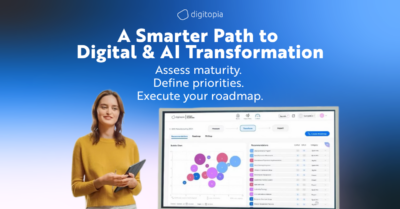
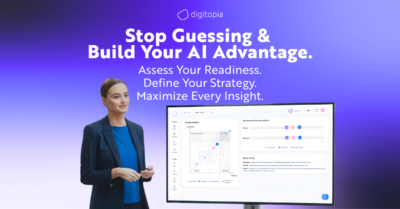
A maturity assessment is not a score. It is a management instrument. Done properly, it creates a credible baseline, reveals the capability gaps that block value creation, and aligns leadership on a sequenced roadmap that turns ambition into measurable outcomes. Maturity becomes valuable when it helps leadership answer three hard questions with evidence: Where are we today? Where do we want to be? What must change first?
Step 1: Assessment, Know Where You Are Before You Declare Where You Are Going
Most companies are not failing because they lack ideas. They are failing because they lack a shared reality.
One team thinks the bottleneck is technology. Another thinks it is talent. A third thinks it is governance. A fourth believes everything is urgent.
DAIMI starts by creating a common fact base.
That means understanding where you are today, not only internally but also relative to peers. It means looking holistically at the business, not just at IT or data or one AI use case. It means being honest about maturity across the full transformation landscape: strategy, governance and leadership, organizational model, operational model, business model, technology, data and security, and risk, governance and ethics. That is the level of completeness AI transformation now demands.
The logic is simple: Assessment → Strategy → Execution.
First, know where you are. Then, compare against peers. Then, define where you must be. Then, prioritize what you must do. Then, execute with discipline.
That sounds simple. It is not. But it is the only serious alternative to AI-flavored chaos.
Maturity is economically meaningful when it helps leaders establish a baseline, identify gaps, and choose a coherent sequence of investments instead of scattering effort across disconnected initiatives. Higher digital and AI maturity correlates with stronger growth, profit, and organizational performance relative to industry averages.
Step 2: Strategy, Define Where You Must Be and What You Will Not Do
The middle part is strategy.
This is where AI transformation usually becomes fuzzy. Companies say they want to be AI-first, data-driven, or customer-centric, but very few can translate that into clear choices.
What kind of organization are we becoming? Which capabilities matter most? Where do we need velocity, and where do we need endurance? What has to change in the business model, not just in the tech stack? What do we stop doing?
Not everything in transformation moves with the same tempo. Direction, operations, and business model may require speed. Organization, technology foundations, and governance require staying power. Transformation is not only about velocity. It is also about endurance.
So let’s make it practical.
Does your transformation have a name? Does it have a clear target? Does it have a champion? Does it have a guiding coalition? Does it create real urgency? Does everyone understand the priorities?
If the answer to those questions is vague, then the transformation is vague.
In the TOGG case, the first DAIMI baseline did not just produce a diagnosis. It sharpened management focus, clarified priorities, improved sequencing, and accelerated alignment across the transformation agenda. That is strategy at its best: not abstract ambition, but clearer direction.
Step 3: Execution, Where AI Transformation Succeeds or Quietly Fails
The second half is where the hard work begins.
Execution.
This is where many AI and digital transformations quietly fail. Not because the strategy was wrong, but because the enterprise cannot absorb the volume of change. Too many projects. Too few decision rights. Weak governance. No prioritization discipline. Change fatigue. Invisible dependencies. Burned-out teams. No cadence. No follow-through.
That is why governance, TMO discipline, program and portfolio management, and change management matter more now, not less.
If AI is increasing the pace, complexity, and interconnectedness of change, then enterprises need stronger mechanisms to steer, govern, monitor, and execute transformation. They need a real Transformation Management Office, not as bureaucracy, but as an execution engine. They need governance that accelerates decisions rather than slows them. They need change management that makes AI transformation adoptable, not just presentable.
This is also where DAIMI proves its value. In the TOGG example, reassessment helped validate that the roadmap was working, gave management a clearer way to analyze and communicate progress, and supported a cadence of annual assessments plus quarterly QBRs to steer priorities and sustain momentum. The result was not just a better score, but more visible business value and close to 10% improvement in operational efficiency over one year.
That is the real chain:
Business Maturity → Business Strategy → Business Value
Not the other way around.
The Uncomfortable Reality Checks Every Leader Must Face
Before launching the next AI pilot, the next transformation wave, or the next leadership offsite, ask a few more provocative questions:
What is the single most important barrier you must remove to succeed with AI and make your business successful by 2030?
What is the single most important thing you must achieve to succeed with AI and make your business successful by 2030?
Do you need a Chief AI Officer? Why?
Do you need a Transformation Management Office to steer, govern, monitor, and execute your enterprise transformation? Why?
Reality Check: How intelligent is your organization, really? In decisions. In forecasting. In understanding what is going on. In proactively reacting to change. Level 1 is quite dumb and reactive. Level 5 is super intelligent and super preventive.
Reality Check: How truthful, or even ruthless, are you in prioritization, really? Daily tasks, customer complaints, new initiatives, legacy baggage, pet projects, politics. Why? How? Are you sure?
Reality Check: How much work can you truly load on your people, really? What is your real, efficient, sustainable capacity without overwhelming or burning out your people? Why? How? Are you sure?
These are not side questions. These are leadership questions.
From Transform Better to Maximize Impact
This is the core message:
Do not harness FOMO. Harness maturity.
Do not start with AI excitement. Start with assessment.
Do not confuse movement with progress. Translate strategy into priorities and roadmap.
Do not assume AI transformation will execute itself. Install governance, rhythm, and accountability.
Improve maturity. Master change. Create business success.
The companies that win by 2030 will not necessarily be the ones with the most AI tools, the loudest narratives, or the fastest pilots. They will be the ones that understand themselves better, prioritize more honestly, organize more intelligently, and execute more consistently.
That is why the question is no longer whether you should transform.
The real question is:
How much do you want to, can you, or must you transform?