

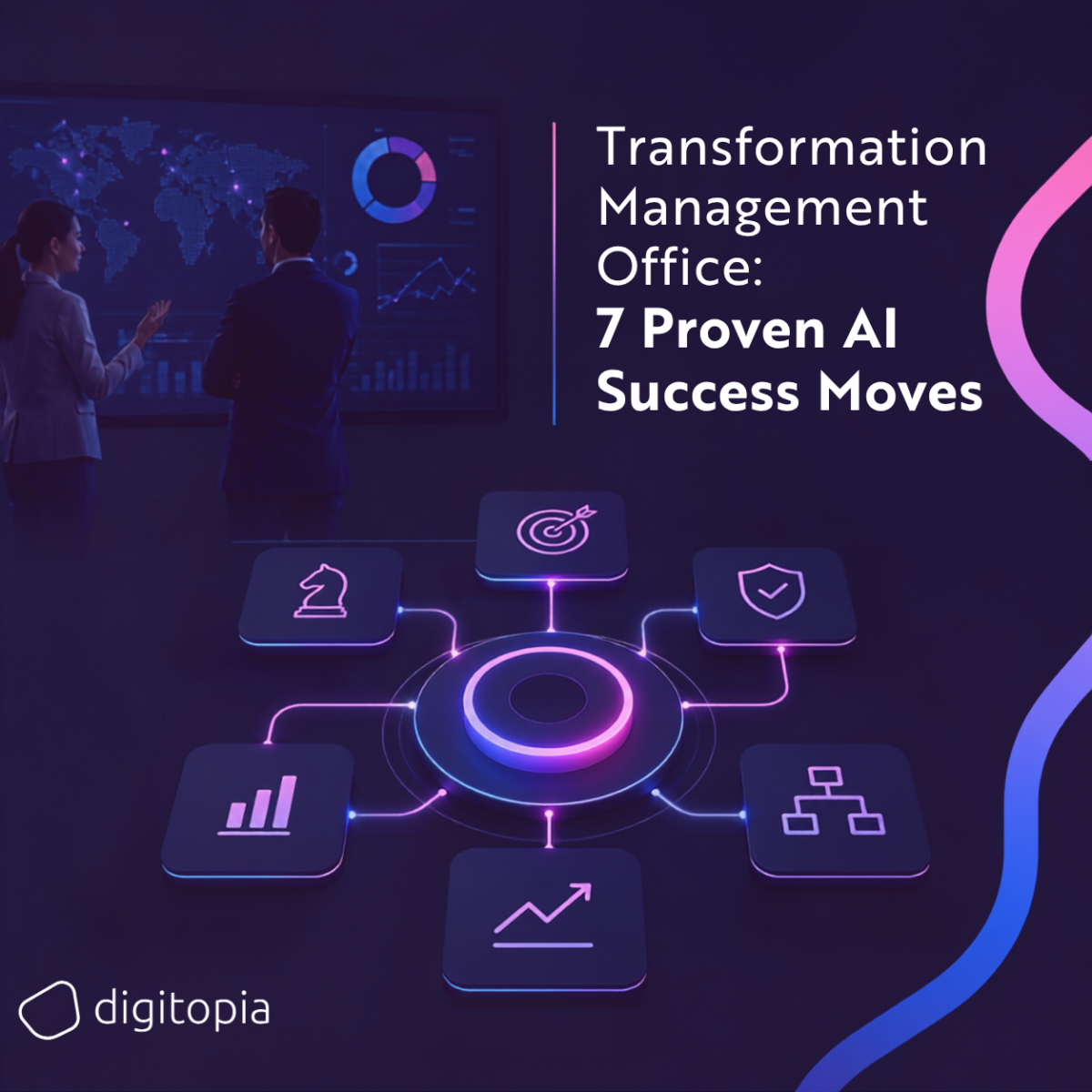
Transformation Management Office: 7 Proven AI Success Moves
AI transformation requires more than isolated pilots, ambitious roadmaps, or occasional steering meetings. A Transformation Management Office connects strategy, governance, priorities, resources, and measurable outcomes, while a capable Chief Transformation Officer keeps enterprise execution coherent.



AI did not create the need for transformation. It made transformation faster, broader, and far more interconnected.
What once looked like a technology program now reaches strategy, governance, operating models, business models, data, talent, risk, culture, and execution at the same time. The real challenge is no longer deciding whether change is necessary. It is building an organization that can absorb, prioritize, steer, and sustain it.
That is why the Transformation Management Office is becoming a critical enterprise capability.
A Transformation Management Office gives leaders a practical mechanism for turning ambition into coordinated execution. It connects priorities, decisions, resources, dependencies, risks, and measurable outcomes. When paired with a capable Chief Transformation Officer, it can prevent transformation from becoming a collection of disconnected projects.
The goal is not more bureaucracy. The goal is managed acceleration.
1. Start With Transformation Maturity, Not More Initiatives
Transformation usually does not fail because leaders lack ambition. It fails because ambition runs ahead of organizational capability.
The strategy points in one direction. Budgets reward another. Business units launch competing initiatives. Teams are overloaded. Governance is too weak to resolve conflicts or too slow to maintain momentum.
Activity increases, but enterprise capability does not.
A Transformation Management Office should begin by establishing a credible maturity baseline.
A maturity assessment is not valuable simply because it produces a score. It is valuable because it helps leadership answer three essential questions:
- Where are we today?
- Where do we need to be?
- What must change first?
Digitopia’s Digital and AI Maturity Index, DAIMI, and Artificial Intelligence Maturity Index, AIMI, turn these questions into a shared fact base. They reveal where ambition is outpacing readiness, where capability gaps are blocking value, and where leadership needs to focus first.
This is the difference between launching another wave of initiatives and building a sequenced transformation roadmap.
Without a baseline, prioritization is influenced by executive preference, internal politics, and whichever technology currently receives the most attention. With a baseline, the Transformation Management Office can steer investment toward the capabilities and initiatives most likely to produce meaningful business impact.
2. Decide Whether You Need a Chief Transformation Officer
Not every company needs a Chief Transformation Officer.
Many companies now do.
The role becomes valuable when transformation is enterprise-wide, multiple business units are interdependent, priorities are contested, change capacity is strained, and no existing executive can orchestrate every dependency.
The Chief Transformation Officer should not own every initiative. That would weaken functional accountability and turn the role into an oversized project management position.
The role should make transformation coherent.
That means translating enterprise ambition into a clear agenda, aligning executives, challenging contradictions, removing barriers, enforcing prioritization, and keeping execution connected to strategy.
The strongest candidate is not necessarily the loudest transformation evangelist. The person must combine strategic clarity with execution discipline.
They must be trusted by the CEO, respected across the executive team, comfortable across business and technology, and willing to escalate difficult trade-offs.
They also need emotional intelligence.
Transformation changes authority, identity, incentives, and established ways of working. A technically correct roadmap can still fail when leaders protect local priorities or employees experience constant change without clarity.
A Chief Transformation Officer is therefore an enterprise integrator, not simply a program monitor.
3. Build the Transformation Management Office as an Engine Room
If the Chief Transformation Officer provides coherence, the Transformation Management Office provides the operating system.
A serious Transformation Management Office is not a reporting factory. It is not a traditional Project Management Office with a new name. It should not exist merely to collect status updates, create presentation decks, or add another approval layer.
Its purpose is to turn strategy into coordinated execution.
A high-performing Transformation Management Office should:
- Steer the transformation portfolio
- Enable faster executive decisions
- Track progress, risks, and dependencies
- Integrate change management into delivery
- Protect strategic focus and organizational capacity
- Connect investment to measurable value
The team should be small, credible, cross-functional, and close to decision-makers.
Its core capabilities may include portfolio governance, roadmap coordination, performance management, change management, communications, risk management, dependency management, and benefits realization.
Finance should help validate value.
HR should support capability building, incentives, role design, and workforce change.
Technology and data leaders should shape architecture, platforms, security, and data readiness.
Business leaders must remain accountable for outcomes.
The Transformation Management Office connects these contributions without taking ownership away from the people responsible for delivering results.
4. Create a Visible Transformation Rhythm
Transformation cannot depend on occasional steering committees or annual strategy reviews.
It needs a visible operating cadence.
A Transformation Management Office should establish a rhythm that keeps decisions, risks, progress, and value moving.
That rhythm may include:
- Monthly steering reviews
- Quarterly business reviews
- Initiative-level performance dashboards
- Dependency and risk escalation
- Benefits tracking
- Leadership decision logs
- Roadmap reviews
- Periodic maturity reassessments
The purpose is not to create more meetings.
Each review should force a decision, remove a barrier, confirm value, or change the allocation of resources.
This matters because transformation can appear healthy while quietly losing coherence. Projects may continue, budgets may remain active, and teams may stay busy even when dependencies are slipping and expected value is disappearing.
A strong Transformation Management Office makes drift visible early.
It asks what changed, what is blocked, what should stop, and where capacity should move next.
The result is not passive oversight. It is active steering.
5. Protect Focus and Change Capacity
AI creates more possibilities than any organization can absorb at once.
Every function can now propose pilots, agents, automations, platforms, and new ways of working. Without portfolio discipline, enthusiasm quickly becomes initiative overload.
When everything is described as strategic, nothing is truly prioritized.
Teams take on transformation work without losing their existing responsibilities. Shared data, technology, security, finance, and legal resources become bottlenecks.
Leaders continue funding low-value projects because stopping them feels politically difficult. The organization becomes exhausted while progress remains fragmented.
A Transformation Management Office must make capacity visible and force trade-offs.
It should identify:
- Which initiatives deserve resources
- Which initiatives should wait
- Which initiatives should stop
- Which foundational gaps must be resolved first
- Which experiments have earned the right to scale
It should also distinguish between experimentation and enterprise commitment.
Not every pilot should scale. Not every successful demonstration deserves a place in the strategic portfolio. A use case may work technically but still lack sufficient value, ownership, data readiness, adoption potential, or scalability.
This is not about slowing innovation.
It is about preventing the organization from scaling confusion.
Focus is one of the most valuable outputs a Transformation Management Office can create.
6. Design Governance for Human and AI Work
AI transformation is not only a technology challenge.
It changes how work is designed, how decisions are made, and how accountability is assigned.
As work becomes more modular and increasingly orchestrated across people, systems, and AI agents, organizations need clear answers to practical governance questions:
- What can AI systems decide or execute?
- Who owns the resulting outcome?
- When is human validation mandatory?
- How are exceptions handled?
- How is ambiguity escalated?
- How are performance, risk, and compliance monitored?
These responsibilities cannot belong to everyone and no one at the same time.
The Transformation Management Office should connect the hard mechanics of governance with the human mechanics of change.
The hard mechanics include decision rights, policies, controls, funding, metrics, risk thresholds, and escalation paths.
The human mechanics include leadership alignment, communication, capability building, incentives, adoption, and trust.
Governance should not be designed as bureaucracy after the technology has already been selected. It should be designed as part of the operating model from the beginning.
When governance works, it speeds up responsible action.
When it is absent, AI enthusiasm outruns organizational readiness.
When it is excessive, valuable initiatives stall before they can demonstrate impact.
The Transformation Management Office must help the enterprise find the disciplined middle ground.
7. Measure Value and Reassess Continuously
Transformation is only real when business value becomes visible.
More pilots, meetings, dashboards, and announcements do not automatically mean progress.
A Transformation Management Office must connect each priority to a clear owner, expected outcome, KPI, timeline, dependency map, and measurable benefit.
It should track both leading and lagging indicators.
Leading indicators may include:
- Adoption
- Data readiness
- Capability development
- Process redesign
- Decision speed
- Milestone completion
- Employee participation
Lagging indicators may include:
- Productivity
- Revenue growth
- Cost reduction
- Customer impact
- Operational efficiency
- Resilience
- Risk reduction
Both matter.
Lagging indicators show whether value was created. Leading indicators show whether the organization is building the capability required to create value consistently.
The roadmap must also remain adaptable.
Transformation plans should not become fixed documents that survive long after their assumptions have expired. Market conditions change. Technologies improve. Business priorities move. New dependencies emerge.
Regular maturity reassessments help leaders understand whether capabilities are improving, whether priorities still make sense, and whether the organization is ready for the next level of ambition.
The Transformation Management Office should therefore manage transformation as a continuous enterprise system, not a temporary program.
When Does a Transformation Management Office Become Necessary?
A Transformation Management Office becomes necessary when transformation is too important, too interconnected, or too difficult to manage through existing functional structures.
The warning signs are usually clear:
- Multiple executives sponsor overlapping initiatives
- Resource conflicts are constant
- Priorities change without transparent decisions
- Projects continue without measurable value
- Governance exists but does not accelerate decisions
- Teams are overloaded by simultaneous change
- Business and technology roadmaps are disconnected
- No one owns cross-enterprise dependencies
- Leadership cannot explain where transformation value is being created
These are not simply project delivery problems.
They indicate that transformation has not been designed as an enterprise management system.
Creating a Transformation Management Office will not automatically solve every problem. A weak mandate, limited executive support, unclear authority, or excessive reporting requirements can turn it into another administrative layer.
Its effectiveness depends on three conditions.
First, it must have direct access to executive decision-makers.
Second, it must have authority to challenge priorities, escalate conflicts, and recommend that low-value work be stopped.
Third, it must be measured by business outcomes and maturity progress, not by the number of reports, meetings, or initiatives it manages.
Without these conditions, the Transformation Management Office may create visibility without creating movement.
Conclusion: Turn Transformation Into a Managed Enterprise Capability
AI is making transformation more necessary and more difficult.
Good intentions, scattered initiatives, and occasional steering committees are no longer enough. Enterprise-critical transformation requires enterprise-grade leadership and execution.
The Chief Transformation Officer provides coherence.
The Transformation Management Office provides focus, governance, cadence, visibility, and follow-through.
Together, they help the organization move from disconnected activity to measurable progress.
Start with maturity, not assumptions.
Establish a credible baseline. Align leadership around the most important gaps. Build a sequenced roadmap. Protect change capacity. Track value. Reassess regularly.
Most importantly, do not confuse transformation with activity.
Transformation becomes real when decisions improve, priorities become clearer, accountability becomes stronger, capacity is protected, and business value becomes visible.