


The Hive in the Supply Chain
A sci-fi business story about IoT, AI, traceability—and the people who fear it.




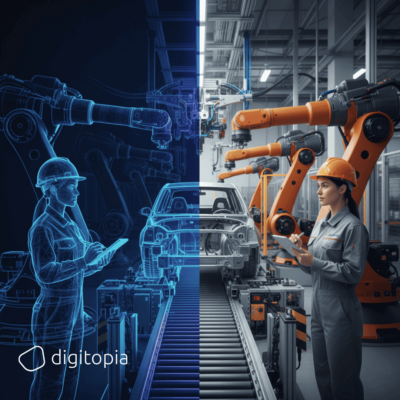
Leila Nasser learned early that the future doesn’t arrive with fanfare. It arrives like fog: quietly, inevitably, until you look up and realize the old landmarks are gone.
On her first day as Head of Digital Transformation at Ardent & Vale—a century-old consumer goods company famous for soaps, shampoos, and household staples—she stood on a mezzanine inside the main distribution center and watched forklifts move like tired insects. Pallets were stacked with an almost religious devotion to routine. Clipboards passed from hand to hand. A supervisor pointed at a printed pick list. Someone scribbled, nodded, vanished into an aisle.
Everything worked. Until it didn’t.
The CEO had recruited Leila with a mandate that sounded simple in a boardroom and brutal in real life:
“Turn this into an end-to-end, integrated, seamless, frictionless value chain. Make it intelligent. Make it traceable. Make it resilient.”
She had said yes because she believed in the mission—and because she had seen what happened to companies that assumed “working” was the same as “future-proof.”
What Leila saw that morning wasn’t a supply chain. It was an archipelago: islands of data, kingdoms of process, and a sea of manual work connecting them.
Procurement had its own system and its own truths. Manufacturing had its own dashboards, calibrated to make yesterday’s problems look like tomorrow’s improvements. Warehousing had an Oracle instance nobody dared touch. Logistics relied on partners whose ETAs were “best guesses with confidence.”
And across all of it hovered the most dangerous thing in transformation: local optimization masquerading as competence.
Leila’s first meeting confirmed it.
They gathered in a glass-walled room called The Bridge—as if naming could conjure reality. To her left sat Viktor Halden, the SVP of Supply Chain, a man whose reputation was “pragmatic” and whose eyes said “territorial.” To her right sat Yasmin Cho, head of Quality and Regulatory, whose standards were legendary and whose patience for buzzwords was famously thin.
Around them: planning, procurement, factory ops, IT security, finance. A full map of the internal empires.
Leila clicked her remote. On the screen appeared a simple image: a honeycomb.
“I’m not here to ‘digitize’ your processes,” she began. “I’m here to connect them. Digitization is scanning clipboards. Transformation is building a nervous system.”
Viktor leaned back. “We’ve done integrations before.”
Leila nodded. “Integrations are bridges between islands. I’m proposing a continent.”
She switched to the next slide: THE HIVE.
A program, not a project. A digitally enabled value chain with:
- IoT instrumentation across plants, warehouses, and transport
- End-to-end traceability down to batch, lot, and container level
- A supply chain control tower with real-time visibility and exception management
- AI-driven demand forecasting and supply planning, tied to S&OP and execution
- A digital twin to simulate decisions before they became expensive
- A governance spine: master data, security, and operating model redesign
Yasmin crossed her arms. “Traceability is not optional. It’s compliance. We already track.”
Leila smiled gently. “You track. But you don’t know. There’s a difference between recording and understanding. Right now, you have breadcrumbs. I’m proposing a map.”
Viktor tapped his pen. “And how many millions is this map going to cost?”
Leila didn’t flinch. “Fewer than the next stockout crisis. Fewer than the next recall. Fewer than losing shelf space because we can’t prove provenance in hours instead of weeks.”
There was a pause—one of those corporate silences where people decide whether to treat you as a visionary or a threat.
Then the threat arrived.
It didn’t come from Viktor or Yasmin. It came from Elias Morek, head of regional distribution, who spoke like a man defending a border.
“Visibility is a nice word,” Elias said. “But people don’t understand our reality. Warehouses are… human. There are workarounds for a reason.”
Leila looked at him. “Workarounds are symptoms. The question is: what are we treating them as—craftsmanship or disease?”
Elias’s mouth tightened. Viktor’s eyes narrowed, amused. The kingdoms had noticed the new cartographer.
The First Thread of Light
Leila didn’t start with a grand redesign. She started with a pilot that would earn trust in the only currency executives never counterfeit: operational impact.
One product line. One plant. One distribution center. One transport lane.
She chose their bestselling detergent pods—high margin, high volume, high sensitivity to promotional spikes. The kind of product whose forecast error showed up in quarterly results.
She built a small cross-functional “Hive Cell,” pulling in a planner, a warehouse supervisor, a plant engineer, a data architect, and a cybersecurity lead. She didn’t ask for volunteers. She asked for builders. The ones who were tired of pretending the current system was fine.
Then she instrumented reality.
They placed IoT sensors on critical mixers to capture run-time, temperature stability, and micro-stoppages. They attached smart tags to pallets—low-energy, mesh-enabled labels that could “chirp” their identity and condition across the warehouse. They integrated transport telemetry: location, temperature, shock events, door openings.
The tags weren’t bees. But in Leila’s mind they behaved like a swarm: thousands of tiny signals, each meaningless alone, powerful together.
They fed these signals into a new layer—an event-driven platform that didn’t just store data, but recognized moments: batch completed, pallet staged, truck departed, arrival deviation, temperature excursion, shelf-life risk.
Over it all, she placed the control tower interface: a living dashboard that didn’t scream metrics—it whispered priorities.
Exception-led. Root-cause oriented. Designed for humans who had to act, not analysts who had to admire.
On week three, the control tower flagged something no one had ever seen before:
A recurring delay pattern between packaging and outbound staging—only on Tuesdays, only for one shift, only when a particular supervisor was on duty.
The planner blinked. “We always assumed Tuesday was just busy.”
The warehouse supervisor frowned. “Tuesday is when we… do the manual reconciliation.”
Leila didn’t say why is this still manual out loud. She simply asked, “What triggers the reconciliation?”
A pause.
Then, quietly: “We don’t trust the inventory file.”
There it was. The truth beneath the workaround.
The Hive Cell fixed it—not with blame, but with data governance, master data reconciliation, and a redesigned handoff process. One small kingdom—inventory control—had been guarding a broken ritual because the system had stopped deserving trust years ago.
Once the trust returned, the ritual disappeared.
For the first time, Tuesday looked like every other day.
When the plant hit 98% on-time staging that month, the CFO asked for a demo.
And when the CFO asked, the kingdoms listened.
The War of Small Kingdoms
Success is not a victory in transformation. It is a provocation.
As the pilot expanded, resistance emerged in its familiar forms:
- “We tried this before.” (Translation: we failed before, and we want you to fail too.)
- “This will slow us down.” (Translation: it will slow down our ability to hide.)
- “Security won’t allow it.” (Sometimes true. Often weaponized.)
- “Our processes are unique.” (Translation: our exceptions are our power.)
Viktor began asking questions in steering meetings that sounded like curiosity and landed like sabotage.
“How do we know the sensors are accurate?”
“Why does planning need transport data?”
“Are we sure AI forecasting won’t confuse the team?”
Leila answered each question with the same discipline: data, pilots, governance, and respect.
But she also understood the emotional layer. Digital transformation is not a technology program. It is a reallocation of certainty.
People didn’t fear dashboards. They feared what dashboards did to their identity.
For years, many managers were valued because they could “solve problems.” The new system made problems visible earlier—sometimes before the manager even knew they existed. That felt like displacement.
Leila addressed it directly in a town hall:
“The Hive is not replacing expertise. It is removing ambiguity. In an ambiguous system, power comes from being the translator. In a transparent system, power comes from being the builder.”
Some applauded. Some looked away. Elias walked out five minutes early.
The Twist: When the Hive Went Quiet
The incident happened on a Thursday—the kind of ordinary day history prefers, because it makes the story more terrifying.
At 09:17, the control tower stopped receiving telemetry from the detergent lane. No pallet chirps. No mixer status. No transport updates.
At 09:20, the dashboard’s green turned to gray.
At 09:23, someone in planning said the words every transformation leader dreads:
“Is the system down?”
Leila was already moving. Cybersecurity joined within minutes. IT checked network health. The event platform showed nothing—no errors, no alarms, just… silence.
Silence is not the absence of information. Silence is information.
Leila stared at the architecture diagram in her head and felt a cold realization: this wasn’t a crash.
This was a cut.
A deliberate severing of the nervous system.
The cybersecurity lead, Anika, confirmed it.
“We’re not seeing a DDoS. No obvious malware. It’s like the sensors are… refusing to speak.”
Leila swallowed. “A firmware lock?”
“Possibly,” Anika said. “Or someone is spoofing the mesh network—flooding it with fake beacons until the real ones can’t be heard.”
Leila felt the boardroom echoes: Hated in the Nation. Tiny devices. Massive consequence.
No one was being attacked. No one was dying. But the logic was similar: if you could hijack the smallest signals, you could poison the whole system.
And in a company trying to build an intelligent value chain, poisoned signals were existential.
Worse, the timing was perfect. Ardent & Vale was entering a peak promotional window. Forecasts were locked. Production was scheduled. Transport capacity was booked.
If the Hive failed now, every skeptic would be validated.
Viktor’s voice cut through a conference call like a blade.
“I warned you about complexity,” he said. “We cannot run the business on experimental tech.”
Leila kept her tone level. “The business is still running. We have manual fallback. But yes—we have an incident. And we will learn from it.”
Elias, on a separate thread, was less disciplined. He emailed half the executive team:
SEE? THIS IS WHY WE KEEP THINGS SIMPLE.
Leila didn’t reply. She did something else.
She asked the control tower team for the last known “good” signature from the tags—an identity baseline. Then she asked quality for the latest batch genealogy snapshots. Then she asked planning for demand signals and allocations.
She began to triangulate.
When the Hive goes quiet, you don’t panic. You listen to everything else.
Within an hour, the pattern emerged: the outage wasn’t random. It affected only one product lane—and only in facilities where a particular third-party contractor had installed the tag readers.
Anika traced the firmware source. It wasn’t their standard deployment package. It was “almost” the same—enough to pass casual inspection, different enough to include a hidden configuration.
It didn’t exfiltrate data. It didn’t destroy systems.
It simply created doubt.
A sabotage designed not to break operations, but to break confidence.
Leila’s stomach tightened, not from fear—but from anger at the elegance of it.
Somebody had turned her transformation into a referendum.
The Countermove: Turning Transparency into Armor
Leila did not respond with speeches. She responded with architecture.
First, she isolated the compromised readers and reverted to a trusted firmware image signed by their own security keys.
Second, she implemented device identity attestation: every sensor and reader had to prove it was itself, cryptographically, before the platform accepted its events.
Third, she created a traceability ledger—not a buzzword blockchain pitch, but a practical, append-only record that made tampering visible.
“Trust is not a feeling,” she told the team. “Trust is a design property.”
By the next morning, telemetry returned. The Hive resumed its hum.
But Leila knew the real crisis wasn’t technical. It was political.
So she did something that made Viktor blink.
She invited him to the war room.
Not to be blamed. To be included.
“Viktor,” she said, “if we turn this into a feud, the business loses. If we turn it into capability, the business wins.”
He studied her. “You think someone internal did this.”
“I think someone wanted the program to fail,” she replied. “Internal or external doesn’t matter as much as the lesson: when a value chain becomes digital, cybersecurity becomes supply assurance.”
She let that sentence settle.
Then she added: “I want you to co-sponsor the security hardening workstream with me.”
It was a subtle move—one management consultants call converting a critic into a stakeholder.
It also robbed the skeptics of oxygen.
Viktor agreed, not because he was convinced, but because refusing would place him on the wrong side of competence.
Within two weeks, the incident was closed and reported to the board—not as a failure, but as an early stress test that the company survived precisely because it had visibility.
And then the final piece clicked into place.
Anika quietly handed Leila a report: a correlation between the compromised reader installs and purchase orders approved through a single procurement channel—an obscure vendor relationship tied to a mid-level manager who reported, indirectly, to Elias.
Leila didn’t need a courtroom. She needed the system to protect itself.
The manager was removed. Vendor controls were tightened. Procurement governance was redesigned so no one person could smuggle risk into the nervous system.
Elias resigned three months later, citing “strategic differences.”
No one mourned the kingdom. The continent was forming.
The New Reality: A Frictionless Value Chain (and a Different Kind of Power)
By the end of the year, Ardent & Vale’s supply chain no longer felt like an archipelago.
The control tower didn’t just show operations—it orchestrated them:
Demand forecasting improved because the AI model learned from promotions, weather patterns, channel shifts, and real-time sell-out signals.
Supply planning became adaptive, with scenario simulations run on the digital twin before changing production schedules.
Quality incidents were isolated in minutes, not days, because batch genealogy was end-to-end.
Transport delays were predicted, not merely reported, because telemetry and historical lane behavior fed exception models.
Warehouse productivity rose not through pressure, but through the removal of pointless reconciliation rituals.
The most surprising change was cultural.
Planners stopped arguing about whose spreadsheet was “right.” They argued about which intervention would protect service levels with the least cost and carbon.
Factory teams stopped hiding micro-stoppages. They used the data to eliminate them.
And the executives—once addicted to retrospective KPIs—started asking forward-looking questions.
“What happens if demand spikes 12% in the south next week?”
“What if our supplier in region X goes offline?”
“What’s the service-risk tradeoff of reducing safety stock by two days?”
Leila watched it unfold with quiet satisfaction. Not because she’d “implemented technology,” but because she’d shifted the company from storytelling to sensing.
One evening, long after most lights were off, she returned to The Bridge alone. The control tower wall displayed the value chain as a living thing—nodes pulsing, exceptions appearing like ripples, recommendations surfacing with calm urgency.
A swarm of tiny signals, harmonized into foresight.
She thought of the old world: clipboards, phone calls, tribal knowledge, heroic firefighting.
Heroism is expensive. Visibility is scalable.
Her phone buzzed. A message from the CEO:
Board loved the resilience story. Next: expand Hive to all categories. Also—can we apply the same approach to sustainability traceability?
Leila smiled.
The future, arriving like fog again.
Before leaving, she looked once more at the honeycomb icon in the corner of the dashboard—the symbol her team had chosen for the program.
In the early days, skeptics joked about it.
Now it felt accurate.
Not because the company had built “smart bees,” but because it had built something rarer:
A system that could sense, learn, and adapt—without depending on empires and workarounds.
And in a world where supply chains could be disrupted by anything—from market shocks to cyber mischief—the most valuable product Ardent & Vale had created wasn’t a detergent pod.
It was trust, engineered into the way the business ran.
What this story tells us (without breaking the spell)
- IoT without governance is just noise. The point is not connectivity; it’s trustworthy events and decision-grade data.
- Traceability is not a feature; it’s an operating model. It changes accountability, quality response, and even brand credibility.
- Control towers must be exception-led. Visibility that doesn’t drive action becomes a wall of screens and a graveyard of attention.
- AI forecasting succeeds when it’s paired with human workflows. Models don’t replace planners; they elevate them—if the process is redesigned.
- Resistance is usually identity, not logic. Kingdoms protect ambiguity because ambiguity creates relevance.
- Cybersecurity is supply assurance. In a digitized value chain, trust must be designed, not assumed.