

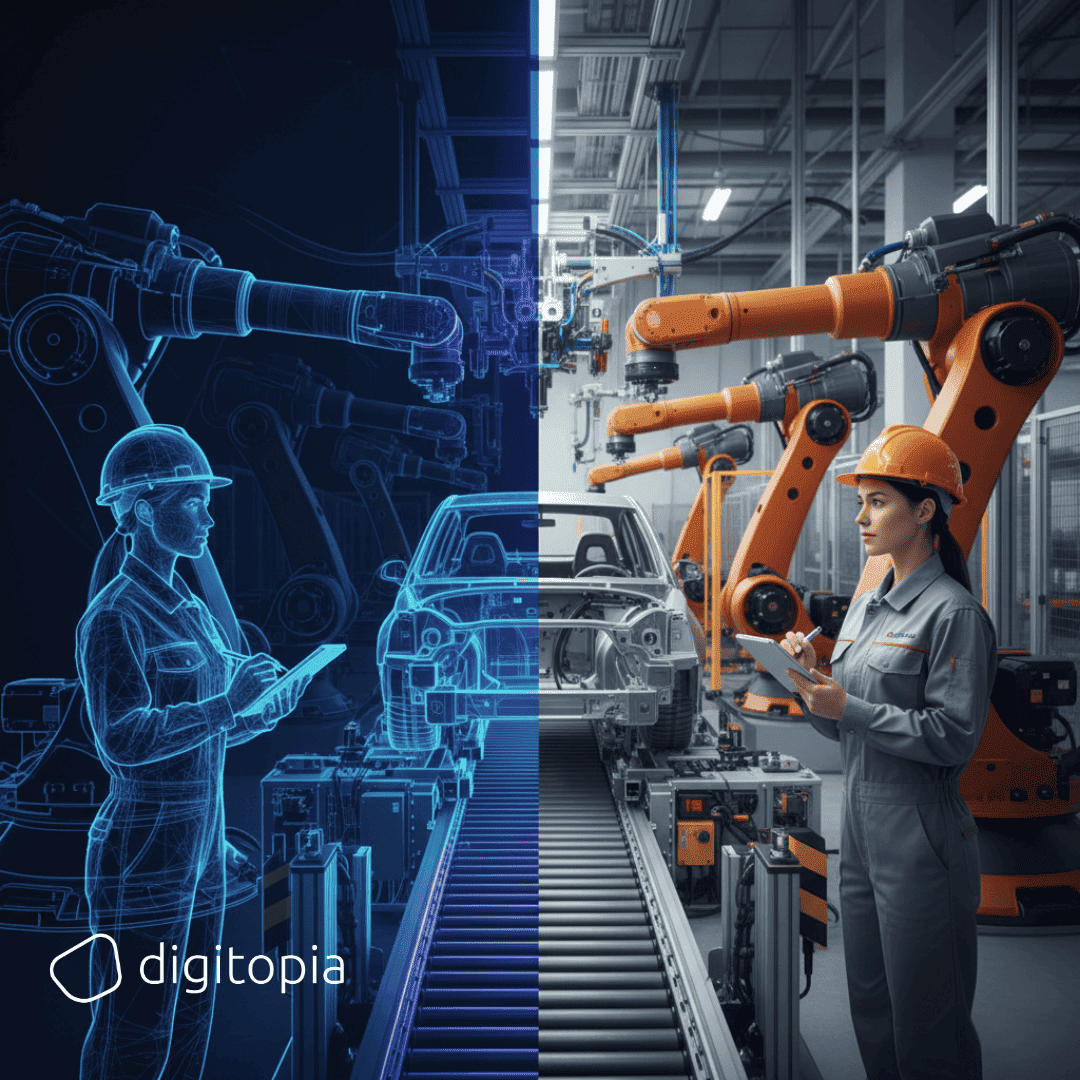
The Second Life of a Factory
A sci-fi business story about digital twins, resilience, and the risks of letting a factory “live” in the cloud.





Aylin Serrin never trusted neat stories about transformation.
In the neat version, a company modernizes, everyone aligns, the technology performs, and the future arrives on schedule.
In the real version, the future arrives unevenly—through gaps in governance, through human pride, through vendors who ship “temporary fixes” that become permanent, through competitors who listen carefully, and through disasters that do not respect roadmaps.
Aylin preferred the real version. It was uglier, but it could be engineered.
That was why Orion AxleWorks hired her.
Orion was an automotive supplier with an enviable footprint: eight factories across three countries, four regional warehouses, dozens of Tier-2 suppliers, and a portfolio of components that lived inside vehicles without ever being seen—precision housings, e-drive subassemblies, thermal management modules, sensor brackets. The kind of parts that were invisible until they were missing.
The CEO described the situation with the weary clarity of someone who had lived through too many surprises.
“We’re efficient,” he said. “But we’re brittle. Every disruption makes us improvise. Every improvisation costs money. And every time we think we understand the system, a new constraint emerges.”
He slid a tablet across the desk. On it was a simple phrase:
PROJECT JUNIPER: THE FACTORY THAT LIVES TWICE.
Aylin raised an eyebrow.
“We want a digital twin,” the CEO continued. “Not a PowerPoint twin. Not a 3D model. A living twin of our plants and warehouses, linked end-to-end. Real-time signals. Simulations. Scenario planning. Learning. So we can forecast, plan, and respond before disruptions become damage.”
The COO added a second sentence, quieter, almost personal:
“And so we can stop relying on heroes.”
Aylin looked from one face to another. She could read the subtext: last year’s supply shock, the late shipments, the expediting costs, the overtime, the customer penalties, the fragile supplier, the near-miss safety incident that never made the board deck.
She nodded once. “A twin that lives is a serious thing,” she said. “It changes the balance of power. It changes accountability. It changes risk.”
The CIO, Soren Malik, leaned forward. “We can build it.”
Aylin met his eyes. “We can. The question is whether we can secure it—digitally and physically. Because once the factory lives in a virtual world, that world becomes a target.”
The CEO smiled, as if she had passed a test without being told there was one.
“That’s why you’re here,” he said.
Aylin accepted. Not because she loved digital twins. She had seen too many become expensive toys.
She accepted because she understood what Orion was really asking for:
To make a manufacturing network capable of remembering, anticipating, and surviving.
To give the company a second life—so the first one would not be lost.
The First Life: A Network of Brilliant Chaos
On her first week, Aylin traveled.
She walked factories the way a doctor walks a ward—watching, listening, and noticing what people stopped noticing long ago.
At Plant 3, she watched a line supervisor “solve” a recurring bottleneck by reassigning an operator every time a specific machine ran a particular SKU. The operator did it without complaint, because the workaround had become tradition.
At Plant 5, she saw preventive maintenance scheduled by calendar rather than condition. Machines were serviced “because it’s time,” not because they needed it—and sometimes because the planner didn’t want to argue with production.
At Warehouse North, she watched a pallet move three times before it found its final location, because the system’s slotting logic didn’t reflect what people actually did when urgency trumped elegance.
And everywhere, she saw the same pattern:
- Data existed, but it wasn’t connected.
- KPIs existed, but they weren’t causal.
- Plans existed, but they weren’t trusted.
- Safety systems existed, but they weren’t always integrated into decision-making.
Orion didn’t lack intelligence. It lacked a shared reality.
In the headquarters war room—an old space repurposed with screens and whiteboards—Aylin asked the leadership team a question that sounded innocent and landed like a provocation.
“If a pandemic hits again, or a major supplier goes dark, or a port shuts down, how fast can you answer three questions?”
She wrote them on the board:
- What will break first?
- What can we do now to prevent it?
- What is the safest way to keep producing?
The COO exhaled. “We’d… call people. We’d run spreadsheets. We’d make decisions with imperfect info.”
Aylin nodded. “That is bravery. Not resilience.”
Then she drew a box around the questions and wrote a single line beneath:
The twin must answer these faster than humans can panic.
Project Juniper: The Factory That Lives Twice
Aylin built Juniper with an engineer’s respect for complexity and a strategist’s hatred for ambiguity.
She broke the twin into four layers, each with explicit safety and security requirements:
1) Reality Capture
The twin’s “senses”—machine telemetry, energy use, OEE signals, WMS events, quality measurements, maintenance logs, environmental sensors, transport ETAs, supplier delivery confirmations.
Not just IoT. Operational truth.
2) Process Model
The twin’s “body”—the actual process flow: routing, cycle times, changeovers, labor constraints, tooling availability, warehouse slotting, pick/pack, dock scheduling, transportation lanes.
This was where most twins failed—too much geometry, not enough operations.
3) Decision & Simulation
The twin’s “mind”—scenario simulations, constraints-based planning, demand and supply forecasting, inventory optimization, predictive maintenance, and AI-driven anomaly detection.
4) Governance & Safety
The twin’s “immune system”—cybersecurity, physical security interfaces, safety constraints, access control, audit trails, incident response playbooks, and rules that prevented “virtual decisions” from creating unsafe “physical actions.”
Aylin insisted on one principle that annoyed some of the engineers:
The twin is not a toy. It is a safety-critical decision environment.
They started with one factory and one warehouse, then expanded like a nervous system:
- Plant 2 (machining-heavy, high changeover complexity)
- Warehouse East (volatile SKU mix, frequent expediting)
Aylin built a cross-functional “Twin Cell”: manufacturing engineering, IT, OT security, planning, maintenance, EHS, and warehouse ops.
She also did something political early: she made EHS co-own the program.
The plant managers didn’t like that at first.
“Why is safety steering this?” one asked.
Aylin answered calmly. “Because if the twin can optimize output at the expense of safe operation, it will. Not maliciously—mathematically. Safety has to be a hard constraint, not a slide.”
They integrated safety constraints into simulations: maximum allowed throughput before congestion increased near-miss probability; forklift traffic rules; temperature thresholds; hazardous material handling limits; ergonomic limits on manual handling.
The twin didn’t just model production.
It modeled safe production.
Within three months, Juniper achieved something that made the COO lean forward like a man hearing music in a room that used to be silent.
It showed the company where it was lying to itself.
Not intentionally. Systemically.
The twin highlighted that “capacity” wasn’t one number. It was a shifting boundary determined by changeovers, tool wear, staffing, and upstream variability.
It showed that inventory buffers weren’t “just stock.” They were compensation for process uncertainty.
It showed that a machine’s “availability” wasn’t a maintenance metric. It was a planning dependency.
And it showed a startling fact: certain late shipments had been inevitable—baked into the network by scheduling rules that looked reasonable on paper but collided in reality.
The twin made these collisions visible before they happened.
For the first time, Orion could simulate next week and see the bottlenecks forming like weather systems.
Aylin watched executives react with a mix of relief and discomfort.
Relief: because the chaos had a shape.
Discomfort: because the shape pointed to decisions they had defended for years.
That discomfort is where transformation begins.
The Second Life: A Factory That Can Practice Disaster
Aylin’s favorite capability wasn’t real-time monitoring. It was rehearsal.
She called it Continuity Theater—a controlled set of simulations that let Orion practice discontinuities without paying for them in production.
They built a library of scenarios:
- Pandemic Variant: workforce reduction, staggered shifts, absenteeism spikes
- Supplier Blackout: Tier-2 shutdown for 30 days, long lead time, limited substitutes
- Transport Breakdown: port closures, lane delays, fuel constraints
- Demand Shock: sudden demand surge in one customer program; collapse in another
- Energy Volatility: peak pricing, rolling brownouts, energy curtailment orders
- Natural Disaster: warehouse region inaccessible; inventory stranded
- Quality Crisis: suspected defect in a batch; containment and traceability exercise
- Cyber Incident: forced segmentation of OT network; restricted visibility; safe-mode operations
Each simulation produced not just a forecast, but a playbook:
- What to prioritize
- What to pause
- What to substitute
- What to communicate
- Which safety constraints become critical under stress
- Where the network is most fragile
Then Aylin added AI—not as a marketing flourish, but as a learning mechanism.
They trained models on past disruptions and simulated outcomes to recommend countermeasures:
- alternate routing suggestions
- proactive inventory rebalancing
- dynamic safety stock adjustments
- predictive maintenance shifts based on stressed utilization
- labor redeployment plans that respected training and safety requirements
The twin became a teacher. The company became a student.
By the time Juniper expanded to the third and fourth factories, the organization had begun to change.
Plant managers started asking: “What does the twin say?” not as obedience, but as a common reference.
Planners stopped arguing about whose spreadsheet was correct and started arguing about which scenario they were actually in.
Maintenance teams used condition signals to schedule interventions before breakdowns.
Warehouse teams used digital slotting simulations to reduce wasted motion and congestion—improving both productivity and safety.
And Orion’s customers noticed.
Service levels improved. Expediting costs dropped. The quarterly review with the biggest OEM turned from defensive explanations into proactive discussions.
The CEO was delighted.
Which is why the attack landed when confidence was at its peak.
It always does.
The Twist: When the Twin Became a Door
The breach did not begin with malware.
It began with a request.
Aylin received an email from a vendor they had been using for simulation modeling support—an external specialist with excellent credentials and a history of work with industrial twins.
Subject: “Juniper model calibration—requesting read-only access to configuration library.”
It looked routine. It was written in the vendor’s standard style. The signature matched. The tone was familiar.
The Twin Cell approved the request.
That was the first mistake: familiarity masquerading as verification.
The second mistake was older: a “temporary” exemption in the access system for certain documentation folders, created during a hectic onboarding month and never fully revoked.
And then, without alarms, without explosions, without drama, Orion’s second life was opened from the outside.
Not the live telemetry. Not the controls. Not the OT network.
Something quieter.
The configuration library: the playbooks, the simulation parameters, the network constraints, the supplier alternatives, the proprietary process assumptions—basically, Orion’s institutional knowledge about how its manufacturing network truly worked.
In the physical world, these things were scattered in people’s heads, locked in meetings, and buried in files.
In the twin world, they were organized.
Accessible.
Searchable.
Portable.
Aylin learned about the intrusion from an AI anomaly detector—not one built for cybersecurity, but one built to notice planning oddities.
The system flagged unusual model runs at odd hours from an external IP range. The runs weren’t destructive. They were curious. Like someone practicing Orion’s disasters.
Aylin’s stomach tightened.
She called Soren Malik, the CIO, and Ansel Varga, head of OT security.
“Show me access logs,” she said. “Now.”
Ansel’s voice was controlled. “We’re seeing an authenticated session. Vendor credentials.”
Aylin’s tone stayed level. “Authenticate doesn’t mean authorized. What did they access?”
Soren’s face turned gray as he read. “Scenario playbooks. Supplier substitution logic. Warehouse routing constraints. Production routing assumptions. Some internal documentation.”
Aylin stared at the screen where the twin’s map of factories glowed serenely, unaware it had been used.
“Who benefits from knowing how we respond to disruptions?” she asked.
No one answered, because the answer felt like saying a curse.
A competitor would.
A rival supplier with similar components could exploit Orion’s vulnerabilities, undercut bids, anticipate capacity moves, and poach customers by offering resilience—based on Orion’s own playbook.
The twin, built to protect Orion from discontinuities, had become a vulnerability.
Not because the concept was wrong.
Because the governance had not been ruthless enough.
Aylin felt the weight of it—the dual nature of building a living world.
In San Junipero, immortality was offered as escape.
In Juniper, “immortality” of operations had created a new kind of exposure.
Beyond Cybersecurity: Twin Security and Twin Safety
Aylin refused to treat the intrusion as merely a cyber incident.
Cybersecurity was necessary, but insufficient. Juniper was not just data—it was a decision environment connected to physical realities.
So she framed the response in three domains:
Domain 1: Digital Security
Identity, access, audit, segmentation, encryption, attestation.
Domain 2: Model Integrity
Protecting the twin from manipulation, poisoning, and subtle corruption of assumptions—because a twin that produces wrong decisions is as dangerous as one that leaks secrets.
Domain 3: Physical Safety & Security
Ensuring that actions derived from the twin could not compromise safety in factories and warehouses, and ensuring that physical operations could continue safely if the twin were degraded or unavailable.
Aylin called an emergency executive session—not to blame, but to reset the rules of reality.
She stood in front of the group and said:
“We have built a second life for our operations. That second life must be treated like critical infrastructure. We do not secure it like an app. We secure it like a power plant.”
She then made four non-negotiable decisions.
The Countermove: Making Juniper Trustworthy
1) The Twin Becomes a Zero-Trust Environment
No implicit trust based on vendor relationship, location, or role seniority.
- Just-in-time access with expiration
- Per-session risk scoring and step-up authentication
- Mandatory device posture checks
- Network micro-segmentation between data domains
- Continuous audit and automated anomaly escalation
Vendor access was redesigned so that no external party could browse institutional knowledge libraries freely. Instead, they could request specific artifacts, which were watermarked, time-limited, and delivered through a controlled portal.
2) Classified Architecture: Not All Memory Lives in One Place
Aylin introduced data classification into the twin.
- Publicly shareable (non-sensitive) operational metrics
- Internal restricted (routine operations)
- Confidential (process assumptions, supplier alternatives, scenario playbooks)
- Safety-critical (constraints, EHS models, emergency procedures)
The most sensitive elements were isolated in a “vaulted twin”—a twin within the twin—accessible only to a small group under strict controls.
This wasn’t bureaucracy. It was survival.
3) Model Integrity Protection
They implemented controls to detect and prevent manipulation:
- Signed model versions and change approval workflows
- “Two-person rule” for changes to critical constraints
- Automated regression tests: if a model change altered outputs beyond thresholds, it triggered review
- Data poisoning defenses: monitoring for anomalous input patterns that could distort learning systems
Aylin’s guiding phrase became: Trustworthy AI requires trustworthy data, and trustworthy data requires trustworthy access.
4) Safe Mode for the Physical World
Aylin worked with EHS and operations to define “safe-mode operations” if the twin was compromised or unavailable.
The principle: the twin advises; it does not command.
- No automatic execution of plan changes without human approval
- Safety constraints enforced locally at the plant level even if the twin suggests otherwise
- Manual fallback procedures, rehearsed quarterly
- Incident drills: if the twin goes dark, operations continue safely, albeit less optimally
They treated it like aviation: autopilot helps, but the pilot remains responsible. And pilots train for failures.
The Reveal: The Intruder Was Not a Phantom
The investigation took an unexpected turn.
The vendor who “requested access” had not requested it.
Their email account had been compromised. The attacker used their identity to gain entry.
Ansel traced the access path and found a pattern: the intrusion originated from infrastructure associated with a consulting boutique known to quietly support Orion’s most aggressive competitor, VectraMotion.
They could not prove direct corporate involvement without legal escalation. But they could infer intent.
Aylin did not pursue revenge.
She pursued advantage.
“Let them have what they stole,” she told the CEO privately. “But let’s make it obsolete.”
The CEO blinked. “Obsolete?”
Aylin nodded. “If they stole last month’s playbook, then our playbook must evolve faster than theft. The twin must become a learning system, not a static library.”
This was the moment Juniper became more than a tool.
It became a strategy.
Aylin accelerated the twin’s cadence:
- weekly scenario refresh
- continuous learning updates
- automated playbook generation with human validation
- faster onboarding of supplier alternatives
- tighter coupling of customer demand changes into simulation cycles
The competitor might have gained a snapshot.
Orion gained a moving target.
The Payoff: Resilience as a Competitive Capability
Three months later, the discontinuity arrived.
Not a pandemic. Not an earthquake.
Something more modern and more mundane: a multi-week cyber incident at a major logistics provider that disrupted several transport lanes across regions. Ports slowed. Customs clearance times became unpredictable. Carriers rationed capacity.
The old Orion would have panicked. Plants would have built the wrong inventory, warehouses would have congested, expedite costs would have soared, and customers would have demanded daily explanations.
The new Orion rehearsed.
Juniper ran continuity theater simulations overnight and produced a ranked set of options:
- pre-position critical components near customer plants
- switch certain SKUs to alternate production routings at different factories
- adjust batch sizes to reduce changeover penalties under constrained transport
- prioritize high-penalty customer programs while delaying low-penalty ones
- use constrained planning that respected safety and labor limits
- deploy a safe shift model to maintain output without fatigue risk
Aylin chaired the response meeting. It was short. Decisions were made with clarity.
And then something rare happened: the factories kept operating smoothly.
Not perfectly. But predictably. Safely. With control.
A week into the disruption, an OEM customer called the CEO.
“We’re seeing issues everywhere,” the customer said. “But you’re stable. How?”
The CEO looked across the room at Aylin and answered simply:
“We learned to practice the future.”
The Human Ending: What the Twin Changed
At the annual leadership conference, Orion’s CEO introduced Aylin with unusual humility.
“Aylin didn’t just build a digital twin,” he said. “She built a new kind of company. One that learns. One that rehearses. One that treats safety and security as design properties, not afterthoughts.”
Aylin took the stage and did not show flashy renders.
She showed three slides.
Slide 1: A Twin Without Governance Is a Leak.
Slide 2: A Twin Without Integrity Is a Lie.
Slide 3: A Twin Without Safety Is a Hazard.
Then she showed the fourth.
Slide 4: A Twin Done Right Is Resilience You Can Sell.
After the applause, a plant manager approached her, the kind who once dismissed the program as “headquarters theater.”
“I used to think this was about computers,” he said. “But… it’s about calm. We’re calmer now.”
Aylin nodded. “Calm is engineered.”
That night, she visited one of the factories. She stood on a mezzanine like she had in her first week at Orion, watching the lines run.
Somewhere in the cloud, the twin mirrored each motion, not to control it, but to understand it.
The factory lived twice.
Once in steel and noise and human hands.
Once in a quiet world of models and simulations.
The second life did not replace the first.
It protected it.
And if the future brought pandemics, port closures, supplier failures, energy shocks, or new kinds of sabotage—Orion would not have to improvise blindly.
Because it had built the rarest capability in manufacturing:
A system that could learn from discontinuity without being destroyed by it.
What this story tells us (without breaking the spell)
- Digital twins are decision environments, not 3D models. Their value comes from connecting telemetry, constraints, and planning into actionable simulations.
- Twin security is broader than cybersecurity. You must protect access, model integrity, and safety-critical decision pathways.
- A digital twin concentrates institutional knowledge. That is power—and a target. Treat it like critical infrastructure.
- Resilience can be rehearsed. Continuity simulations turn “unknown unknowns” into practiced responses.
- AI is useful when it learns from scenarios, not when it decorates dashboards. But learning systems require careful controls against poisoning and drift.
- The physical world must have safe-mode autonomy. If the twin fails, factories still operate safely.